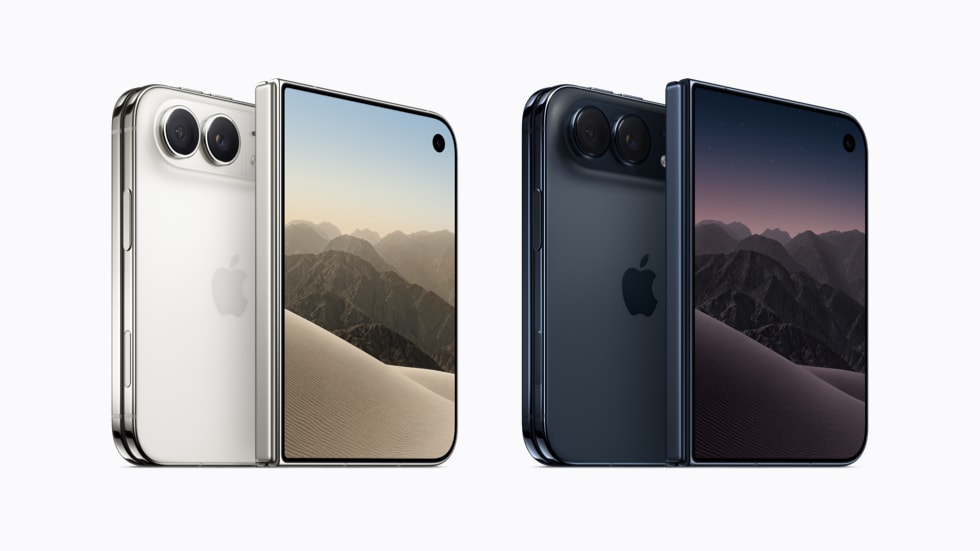
The iPhone Duo is Apple's first foldable iPhone, pairing a 5.4-inch outer display with a 7.6-inch inner display in a grade 5 titanium body built around the same A20 Pro chip that powers the iPhone 18 Pro. Apple made two deliberate trade-offs to fit that hardware into a foldable form factor: Touch ID replaces Face ID entirely, and there's no dedicated telephoto lens, with 2x zoom instead cropped from the 48MP Fusion main camera. The dual-battery design is rated for up to 44 hours of outer-display video playback, and the phone ships IP68 water resistant with MagSafe support intact. Pre-orders open October 16 ahead of an October 23 Canadian launch starting at $2,999 CAD for 256GB, but independent hands-on testing of hinge durability and real-world battery life doesn't exist yet.
Pros
- Apple's first foldable iPhone — a 5.4-inch outer display and 7.6-inch inner display in a single grade 5 titanium body, per Apple's own announcement
- Same A20 Pro chip (2-nanometer) as the iPhone 18 Pro, Apple's most efficient chip yet
- Dual-battery design rated up to 44 hours of video playback on the outer display
- MagSafe support and Wi-Fi 7/Bluetooth 6 connectivity carried over from Apple's current flagship lineup
- IP68 water resistance and a hinge Apple says is built from more than 100 components for long-term durability
Cons
- Touch ID replaces Face ID on this generation — no Face ID at all, per Apple's own spec page
- No dedicated telephoto lens; zoom relies on a 2x crop from the 48MP Fusion main camera
- Starts at $2,999 CAD for 256GB, rising to $4,799 CAD for the 2TB model — a significant premium over Apple's non-folding Pro lineup
- No independent hands-on testing exists yet ahead of the October 23 launch — hinge durability and crease visibility remain unverified
As an Amazon Associate I earn from qualifying purchases. Disclosure
Overview
Apple’s iPhone Duo — its first foldable iPhone — isn’t available for purchase in Canada yet, so this is what’s confirmed straight from Apple’s own September 9 announcement and spec page, not a completed buying verdict. Pre-orders open October 16 through Apple.ca, and Canada is among the first wave of more than 70 countries getting the phone on October 23, starting at $2,999 CAD for the 256GB model, per iPhone in Canada’s coverage of the Canadian pricing.
The whole point of the design is the fold itself: a 5.4-inch outer display for quick tasks and a 7.6-inch inner display that opens flat for the phone’s main experience, both built around the A20 Pro — the same 2-nanometer chip powering the iPhone 18 Pro. Apple made two deliberate trade-offs to fit that hardware into a foldable body: Touch ID, built into the side button, replaces Face ID entirely, and there’s no dedicated telephoto lens — zoom instead relies on a 2x crop from the 48MP Fusion main camera.
Key Specifications
| Outer Display | 5.4-inch Super Retina XDR OLED |
| Inner Display | 7.6-inch Super Retina XDR OLED, nano-texture finish |
| Chip | A20 Pro — Apple’s first 2-nanometer chip |
| Rear Cameras | Dual 48MP system (Fusion Main + Ultra Wide); 2x zoom via sensor crop, no dedicated telephoto lens |
| Front Cameras | 12MP outer (Center Stage); hidden under-display camera on inner screen |
| Authentication | Touch ID (side button) — no Face ID |
| Battery (Rated) | Up to 44 hours video (outer display) / 31 hours (inner display) |
| Storage Options | 256GB, 512GB, 1TB, 2TB |
| Colors | Star White, Night Sky |
| Fast Charging | Up to 50% in about 20 minutes, wired |
| Software | Ships with iOS 27.1 |
| Release Date | October 23, 2026 |
Apple iPhone Duo Cameras
The rear camera system pairs a 48MP Fusion main camera with a 48MP Ultra Wide, the same sensors Apple already uses on the iPhone 18 Pro line, according to Apple’s own September 9 announcement. There’s no separate telephoto lens on the iPhone Duo — Apple describes an “integrated optical 2x Telephoto” captured directly off the 48MP Fusion sensor rather than a dedicated zoom lens, the same sensor-crop approach used on the standard iPhone 18. Photos default to 24MP capture. MacRumors’ compiled spec sheet lists the main camera at an f/1.6 aperture and the Ultra Wide at f/2.2.
Selfies are split across both screens: the outer display uses a 12MP camera with Center Stage framing that rotates for landscape shots, per Apple, while the inner display’s camera is hidden entirely beneath the screen — a 1080p under-display FaceTime camera Apple calls a first for iPhone, per MacRumors’ spec breakdown. Video tops out at 4K120fps in Dolby Vision, with Cinematic mode available up to 60fps and 4K time-lapse support, all according to Apple’s announcement.
Apple iPhone Duo Design, Hinge and Displays
Closed, the iPhone Duo measures 84.1 × 117.8 × 11.3mm; unfolded, it opens flat to 164.6 × 117.8 × 5.2mm, according to MacRumors’ compiled spec sheet — bookended by a 5.4-inch outer display and a 7.6-inch inner display with a nano-texture finish, both rated by Apple at up to 3,000 nits peak brightness with ProMotion and Always-On support. The whole assembly weighs 254 grams, per MacRumors, inside a mirror-polished grade 5 titanium frame Apple says uses a hinge built from more than 100 individual components. Ceramic Shield covers the back, and a newer Ceramic Shield 2 — rated by Apple at 3x better scratch resistance — covers the front. The phone carries an IP68 rating and ships in two colors, Star White and Night Sky.
Apple’s clearest trade-off for the foldable body: Touch ID, integrated into the side button, replaces Face ID entirely on this generation, though it can still unlock via a paired Apple Watch the same way Face ID does on other iPhones, per Apple’s announcement.
Apple iPhone Duo Battery, Charging and Connectivity
Apple built the iPhone Duo around a dual-battery architecture — one cell for each display — rating it at up to 44 hours of video playback on the outer screen, up to 31 hours on the inner display, or up to 24 hours of mixed everyday use. Wired charging reaches 50% in about 20 minutes, and MagSafe wireless charging hits the same 50% mark in roughly 30 minutes, according to Apple’s own announcement.
Connectivity runs through Apple’s own C2 modem with 5G, including mmWave support in the US, paired with an N1 chip handling Wi-Fi 7, Bluetooth 6, and Thread. The phone is eSIM-only worldwide — MacRumors notes it supports dual eSIM — with satellite-based Emergency SOS, Messages, and Find My also on board.
Apple iPhone Duo Software and Multitasking
The iPhone Duo ships with iOS 27.1 and leans on the extra inner-screen space for real multitasking: Apple’s announcement highlights a Split View mode for running two apps side by side and an enhanced StandBy mode built for the dual-display hardware. Apple is also pairing the launch with what it calls an entirely new version of Siri with deeper personal context — the same overhauled assistant debuting on the iPhone 18 Pro line, per Apple’s own materials. Apple Pencil support is planned to arrive later in 2026 via a software update, not at launch.
Is the iPhone Duo Worth Waiting For?
Apple’s own numbers are the only figures available before the October 23 Canadian launch, and a foldable’s real-world durability — hinge longevity, crease visibility on the inner display, how the mechanism holds up to daily folding — is exactly the kind of thing no press release can settle. Anyone weighing whether the trade-offs (Touch ID instead of Face ID, no dedicated telephoto lens, a body that’s noticeably thicker closed than a standard iPhone) are worth $2,999 CAD and up should wait for independent hands-on testing rather than lean on Apple’s specs alone.
Once the iPhone Duo actually reaches Amazon.ca, the two things worth checking against what’s written here are whether Apple’s 44-hour outer-display battery rating holds up under independent testing, and how the inner display’s under-screen FaceTime camera actually performs on real video calls — Apple’s own materials don’t offer a side-by-side comparison against a standard front-facing camera, and that’s the kind of gap early hands-on reviews from named outlets should close quickly after launch.