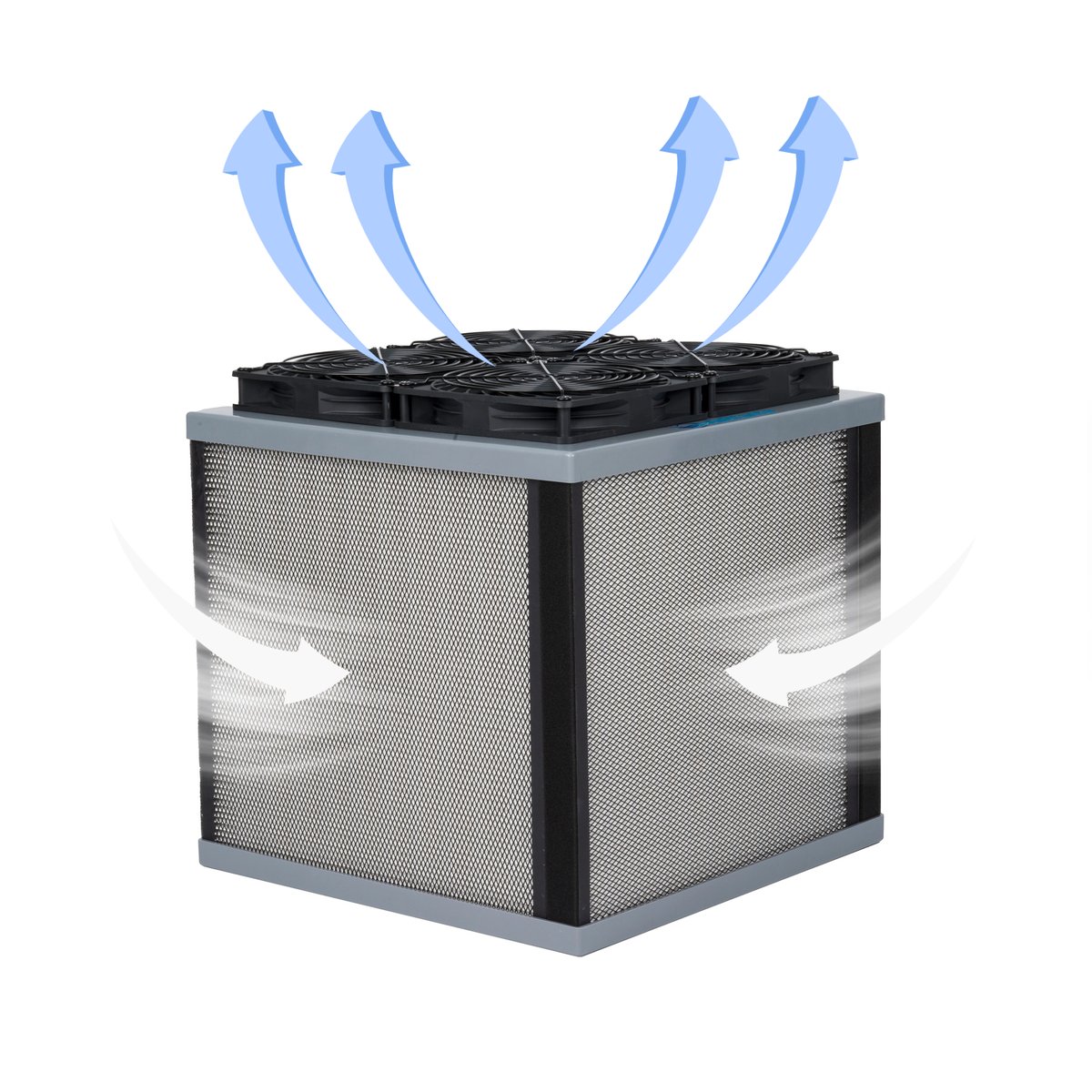
If you want a lot of cleaning power for the money, the AirFanta 3Pro is an easy buy, whether it's for a big living room, a week of wildfire smoke or a hotel stay, and Amazon.ca carries the HEPA edition. Its four fans and four filter panels cleared test rooms about as fast as much bigger purifiers, and it comes apart into a flat stack you can pack. The trade-off is hands-on control: there's no sensor, auto mode or app, so you set the speed yourself, and the top speeds are loud. If you want a purifier that adjusts itself, the Coway AP-1512HH fits better.
Pros
- 413 CFM rated CADR, matched by independent tests
- Cleared test rooms about as fast as much bigger units
- Breaks down flat to pack for travel
- Quiet and frugal at middle speeds
- CARB certified for ozone and electrical safety
Cons
- No sensor, auto mode, app or remote
- Loud at its top speeds
- Only AirFanta's own H11 filters fit
- One-year warranty
As an Amazon Associate I earn from qualifying purchases. Disclosure
Overview
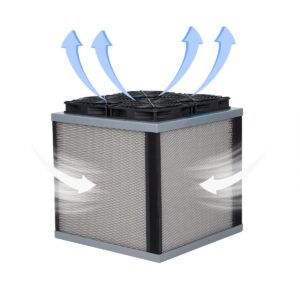
The three big-brand purifiers in our comparison table are rated between 231 and 253 CFM. Against that, AirFanta claims 413 CFM (702 m³/h) for its 3Pro, using a layout borrowed from the Corsi-Rosenthal box: four filter panels standing in a square, with four computer fans on top pulling air through them. It’s built for anyone who wants a lot of filtered air for a large room, a smoky week or a hotel stay. Amazon sells it in two editions, with HEPA filters or with HEPA plus carbon filters; this review covers the HEPA edition, and the carbon option is covered under filters below.
The 3Pro’s designer, engineer Adam Wong, began in 2022 by making Corsi-Rosenthal boxes for people around him, HouseFresh reports; the 3Pro is his version that packs down and reassembles in minutes. The filter panels slot into a plastic base, a lid carrying the fans sits on top, and the whole thing comes apart into a flat stack small enough to pack. Amazon.ca carries the HEPA edition, at $237 CAD as of October 2026. On ozone, Health Canada’s advice is to steer clear of devices that make it and to check CARB’s certification list, and CARB has certified the 3Pro.
Key Specifications
| Price (CAD) | $237 |
| CADR (AirFanta’s rating) | 702 m³/h (413 CFM) on speed 6; about 97 m³/h (57 CFM) on speed 1 |
| Largest room (AirFanta’s claim) | 288 m² (3,100 sq ft) |
| Filtration | Four H11 HEPA panels with a metal mesh face; HEPA + carbon panels optional |
| Filter life | 6 to 12 months |
| Fan speeds | 6, set with a knob |
| Rated noise | 35 dB (speed 1) to 55 dB (speed 6) |
| Rated power | 38 W |
| Power adapter input | 100 to 240 V, 50 to 60 Hz |
| Dimensions (assembled) | 32 x 32 x 32 cm (13 x 13 x 13 in) |
| Weight | 2.7 kg (6 lb) |
| Certifications | CARB certified (Executive Order G-24-200); UL 507 |
| Warranty | 1 year |
AirFanta 3Pro Air Cleaning Performance
The 413 CFM rating isn’t just AirFanta’s word. HouseFresh reports that independent CADR tests by Rob Wissmann and David Elfstrom measured 413 CFM at 12V, the same figure the company publishes for its top speed.
The room tests point the same way. The Smart Air Blast Mini, a far bigger machine, beat it by only two minutes in HouseFresh’s smoke test, where the 3Pro took PM1 to zero in 17 minutes at top speed in a 20.6 m³ (728 cubic ft) room. HouseFresh worked that run out to a PM1 CADR of 353 cfm; at five air changes an hour, that suits rooms up to 49 m² (529 sq ft). Air Purifier First’s hour-long test, run on the carbon-filter edition in a 52 m² (560 sq ft) room, took PM2.5 from 103.2 down to 4.3 µg/m³ (96%), matching the bigger Levoit Core 600S.
BreatheSafeAir’s bedroom test, which its author calls “far from scientific,” shows how the speeds trade off. Incense smoke that took about 90 minutes to settle on its own was cleared in under 20 minutes at speed 6, and the slowest setting took 80.1 minutes. In its runs, stepping down from speed 6 to speed 3 seemed to cost little cleaning time but cut the noise sharply (57 dBA against 71.5 dBA at 30 cm), which is the useful part for everyday running.
For sizing, ignore the number on the box. With a 2.4 m (8-foot) ceiling, 413 CFM changes the air once an hour in about 288 m² (3,100 sq ft), so that’s what AirFanta’s room claim means. At the 4.8 air changes an hour that the rivals’ room ratings use, the same 413 CFM covers about 60 m² (645 sq ft), and HouseFresh’s measured estimate points to about 49 m² (529 sq ft) at five changes. Either figure is well beyond the 33 to 36 m² (358 to 392 sq ft) the rivals in our table are rated for at that standard.
Noise and Energy Use
AirFanta lists 35 dB on speed 1 and 55 dB on speed 6. At the top, testers measured more, and how much depends on where the meter sat: HouseFresh recorded 56.3 dBA from about 0.9 m (three feet), Air Purifier First 62.5 dBA with the carbon panels fitted, and BreatheSafeAir 71.5 dBA at 30 cm and 61.6 dBA at two metres. On the lowest speed the three sit much closer, between about 36 and 40 dBA.
Against other purifiers, it depends on the comparison. The PC-fan kits HouseFresh has tested from Nukit, CleanAirKits and NorthBox Systems all run quieter at full speed than the 3Pro. Against conventional purifiers the testers split: HouseFresh found it quieter at full speed than most mid-sized retail purifiers it has measured, while Air Purifier First’s carbon-edition unit sat near the loudest in its class, though with a much higher CADR. Jeff Kaufman recorded both the 3Pro and his Coway AP-1512 on High. At top speed he judged the noise a match, with the 3Pro moving far more clean air in a tone he liked less. Turned down to speed 4, it still out-delivered the Coway at a much lower volume, and speed 2 was, in his words, “essentially indistinguishable from the background.”
On the older voltage-dial adapter, HouseFresh settled on 6.54 volts as its below-45-dB setting: 43.3 dB on its meter, with the test room clean in 28 minutes. Newer units ship with a six-step speed dial instead, BreatheSafeAir notes, and that reviewer settled on speeds 2 and 3 for everyday use.
Power use stays modest. AirFanta’s manual rates the 3Pro at 38 W, about half the 77 W Coway lists for the AP-1512HH, and the company’s speed chart runs from 2.2 W on speed 1 to 33.2 W on speed 6. HouseFresh’s meter read 43.23 W at the old adapter’s 12.6-volt maximum and 8.98 W at 6.54 volts. Run around the clock at 38 W, that’s about 333 kWh a year; at speed 2 (4.7 W), about 41 kWh.
Filters and Running Costs
The four panels use H11 HEPA media, a grade that captures at least 95% of particles in one pass, below the True HEPA grade some rivals use. That’s a deliberate trade: a less dense filter lets more air through, which is a large part of how the 3Pro reaches its CADR, and a purifier cleans a room by sending the same air through the filter again and again.
Each panel has a metal mesh face that acts as a rough pre-filter for large dust, but it’s attached to the HEPA layer rather than removable for washing. The panels are also AirFanta’s own size, and the manual says to use only official AirFanta filters, so you can’t drop in standard HVAC filters the way you can with a home-built Corsi-Rosenthal box.
The HEPA + carbon edition, or a carbon set bought later, adds 600 g of activated carbon across the four panels. It costs some airflow: in HouseFresh’s test the carbon panels added three minutes, 20 minutes in place of 17. Air Purifier First found them effective against light odours, but not at the level of odour specialists such as the Winix 5510.
A set of four replacement HEPA panels was $79.99 CAD on Amazon.ca on October 3, 2026. The manual says to replace them every 6 to 12 months, so filters run about $80 to $160 CAD a year; AirFanta’s guidance of about nine months at an average PM2.5 of 10 µg/m³ works out to roughly $107 CAD. During a wildfire season with PM2.5 near 90 µg/m³, the company says the filters may need replacing every month, so a smoky Canadian summer can add real cost. Coway’s AP-1512HH filter set was $71.86 CAD on Amazon.ca the same day, and Coway rates its HEPA filter for a year.
AirFanta’s warranty covers defects in materials and workmanship for one year, shorter than the rivals in our table. If a 3Pro fails, HouseFresh reports, AirFanta ships a replacement and doesn’t need the faulty unit back.
Assembly, Controls and Portability
The 3Pro arrives as six flat pieces: the base, four filter panels and the lid with its fans already fitted. You slot the filters into the base with the mesh facing out, wrap the included Velcro strap around them and press the lid on; the manual notes the filters may need a slight squeeze from the side to fit. Testers differ on how easy that is. HouseFresh found it much simpler than the DIY PC-fan kits it has built, Air Purifier First said it took longer than any of the more than 100 purifiers it has unboxed, and Jeff Kaufman found it “a bit annoying to assemble” though it went together well.
Taken apart, it stacks to about 33 x 33 x 14 cm (13 x 13 x 5.5 in), by BreatheSafeAir’s measurement. HouseFresh fitted it in a carry-on and in a backpack; BreatheSafeAir thinks a backpack is a stretch but sees it working in a car or suitcase for hotel stays. The adapter accepts 100 to 240 volts, so abroad it needs only a plug adapter. It weighs about 2.7 kg by AirFanta’s figure of 6 lb, though HouseFresh lists 3.49 kg (7.7 lb), and there are no handles, which Air Purifier First found can make it a bit awkward to move around.
Control is a single speed knob. There’s no air quality sensor or auto mode, no app or remote, and no filter-change reminder, so the fan runs at whatever speed you leave it on. A smart plug can switch it on and off, but only at the speed already set, as Air Purifier First points out. That matters most where pollution comes and goes: Jeff Kaufman keeps his Coway purifiers in the kitchen because they speed up on their own when cooking smoke rises, and uses 3Pros in the living room.
The look is industrial, a filter box with fans on top, but the plastic is solid and the parts fit snugly, even after repeated assembly. A wire guard covers the fans; the manual still says to supervise children near it, and BreatheSafeAir suggests setting it up high where young kids can’t reach the fans.
How Does It Stack Up Against the Competition?
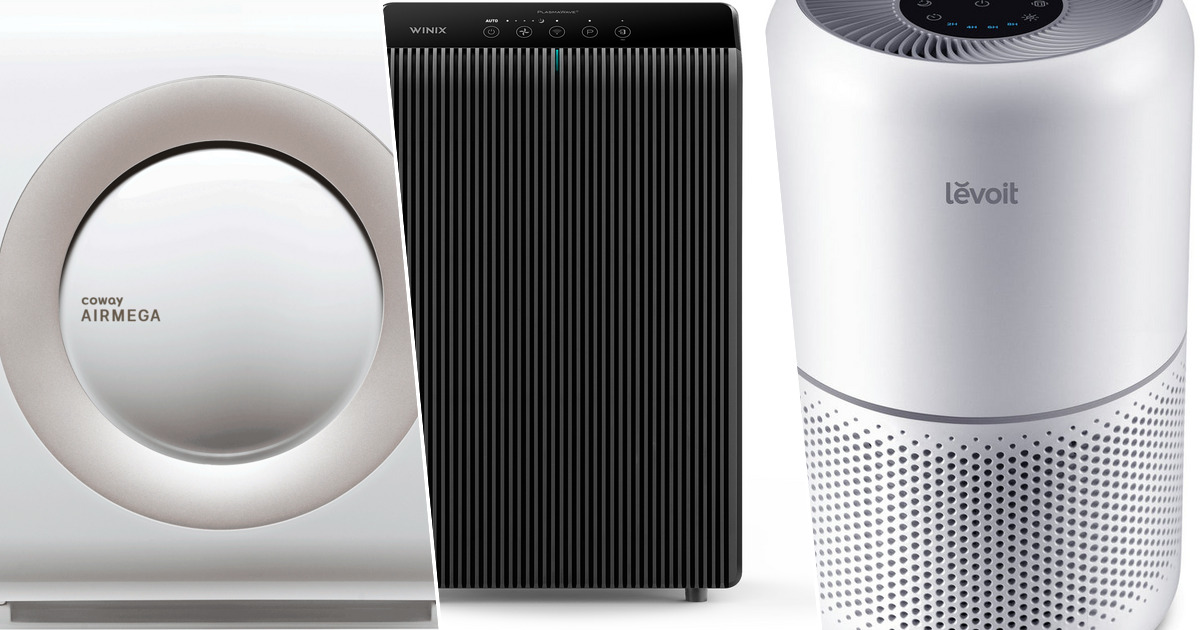
Three large-room HEPA purifiers from the big brands, each already reviewed on this site. Specs are each maker’s figures.
| Feature | AirFanta 3Pro | Coway AP-1512HH | Levoit Core 400S | Winix 5510 |
|---|---|---|---|---|
| Price (CAD) | $237 | Prime deal $201 until Oct 7 | Deal $269.97 until Oct 5 | Prime deal $199.99 until Oct 11 |
| CADR (maker’s figure) | 413 CFM | 233 smoke / 246 dust / 240 pollen CFM | 231 CFM | 253 smoke / 252 dust / 247 pollen CFM |
| Largest room (maker’s claim) | 288 m² (3,100 sq ft) | 162 m² (1,748 sq ft) | 160 m² (1,718 sq ft) | 175 m² (1,882 sq ft) |
| Filtration | Four H11 HEPA panels; carbon optional | Pre-filter, deodorization filter, HEPA filter, bipolar device | 3-stage filter with carbon | Pre-filter, AOC carbon filter, True HEPA filter, PlasmaWave |
| Air quality sensor and auto mode | No | Yes | Yes | Yes |
| Weight | 2.7 kg (6 lb) | 5.5 kg (12.3 lb) | 5.0 kg (11 lb) | 6.0 kg (13.3 lb) |
| Warranty (maker) | 1 year | 3 years (motor and electronics; 1 year other parts) | 2 years | 2 years |
| TTP Review | This review ↑ | Read our review → | Read our review → | Read our review → |
AirFanta’s 413 CFM is its own rating rather than an AHAM-verified smoke figure; HouseFresh estimated 353 cfm for PM1 from its own room test. The Coway and Winix prices were Prime-member deal prices, and the Levoit a limited-time deal, on Amazon.ca on October 3, 2026; their regular Amazon.ca prices were $319, $259.99 and $299.99 CAD. Prices change frequently — always verify current pricing before purchasing.
AirFanta 3Pro: Worth It for Big Rooms and Smoky Days
For a Canadian home bracing for wildfire smoke, the 3Pro is a simple way to get a lot of filtered air into one room. Health Canada’s sizing guide works from floor area: the smoke CADR should be no less than two-thirds of the room’s square footage. By that rule, AirFanta’s 413 CFM rating covers about 58 m² (620 sq ft), and HouseFresh’s lower measured estimate of 353 cfm covers about 49 m² (530 sq ft); AirFanta’s figure isn’t an AHAM smoke rating, so the smaller room is the safer one to plan around. Day to day, leave it in the middle of its range, where it’s easy to live with, and turn it up when smoke rolls in. For a household that runs a purifier around the clock, its low power draw keeps that habit cheap.
If the manual controls described above are a deal-breaker, or the purifier is for a kitchen, our Coway AP-1512HH review covers the model Jeff Kaufman keeps for cooking. If app control matters, the Levoit Core 400S and the Winix 5510 both have one, and for odours the Winix is the stronger choice (see the filters section).
Sources
- AirFanta — 3Pro Product Page and Specifications
- AirFanta — 3Pro User Manual
- California Air Resources Board — Certification of the AirFanta 3Pro (Executive Order G-24-200)
- AirFanta 3Pro — Amazon.ca Product Listing
- HouseFresh — AirFanta 3Pro Review
- BreatheSafeAir — AirFanta 3Pro Review
- Air Purifier First — AirFanta 3Pro Review
- Jeff Kaufman — Comparing the AirFanta 3Pro to the Coway AP-1512
- Coway — Airmega Mighty AP-1512HH Product Page
- Coway — AP-1512HH User Manual and Limited Warranty
- Levoit — Core 400S-P Product Page
- Winix — 5510 Product Page
- Health Canada — Choosing a Portable Air Cleaner
Reader Poll
Where would an AirFanta 3Pro earn its place in your home?
Help Our Editors Know What Matters to You
Explore on Amazon →