The QM7L is the TV to buy if you want TCL's premium SQD color and bright, punchy HDR at a mid-range price: it gets bright enough for a sunny room and keeps blacks deep for movie nights. Its color range matches the QM8L's, and input lag is low enough for console gaming. The trade-off is the glossy screen, which picks up reflections when lamps or windows face it. If you need more than two full-speed HDMI ports, the QM8L or Hisense's U7SG fits better.
Pros
- Bright enough for a sunny room
- Deep blacks from excellent local dimming
- Wide SQD color, matching the QM8L
- Low input lag with 144Hz and VRR
- Google TV with hands-free Gemini
Cons
- Glossy screen picks up reflections from lamps and windows
- Only two of four HDMI ports run at full speed
- Mediocre viewing angle
- Poor HDR accuracy out of the box in RTINGS' test
As an Amazon Associate I earn from qualifying purchases. Disclosure
Overview
The TCL QM7L is the least expensive way into TCL’s 2026 SQD-Mini LED televisions, the color technology the company launched on its X11L flagship earlier in the year. It sits one step below the QM8L and follows last year’s QM7K. TCL opened pre-orders in April 2026 for 55-, 65-, 75-, 85- and 98-inch sizes, and this review covers the 65-inch 65QM7L.
It keeps the QM8L’s Super Quantum Dot color system and its 26-bit backlight controller, then saves money with a simpler panel, fewer dimming zones, lower peak brightness and fewer full-speed HDMI ports. Testers found those cuts easy to live with. TechRadar sees an almost premium TV at a mid-range price and names it the best mid-range TV of 2026. Tom’s Guide calls it its top Mini-LED TV value of the year.
Key Specifications
| Price (USD) | $849.99 |
| Model | 65QM7L (also sold in 55, 75, 85 and 98 inches) |
| Panel and backlight | 4K HVA 2.0 Pro panel; SQD-Mini LED with up to 2,100+ dimming zones (the count rises with screen size) |
| Peak brightness | Up to 3,000 nits (TCL’s rating) |
| Refresh rate | 144Hz native; Game Accelerator 288 (288Hz at 1080p) |
| HDR formats | Dolby Vision IQ, HDR10, HDR10+, HLG; IMAX Enhanced |
| Gaming | VRR, AMD FreeSync Premium Pro, ALLM, Game Bar |
| HDMI | 4 x HDMI 2.1: HDMI 1-2 at 4K 144Hz, HDMI 3-4 at 4K 60Hz; eARC on HDMI 4 |
| Speakers | Audio by Bang & Olufsen; Dolby Atmos, DTS:X; Dolby Atmos FlexConnect (up to 3 Z100 speakers and 1 Z100-SW subwoofer) |
| Smart platform | Google TV with Gemini; Chromecast; Wi-Fi 5, Bluetooth 5.4 |
| Antenna tuner | ATSC 1.0 |
| Stand | Center pedestal, adjustable height |
TCL QM7L Picture Quality
Brightness is a clear step up on last year’s model. Digital Trends measured about 2,800 nits on a 10% HDR window with its 85-inch QM7L, against the 2,000 to 2,400 nits it got from the QM7K. TechRadar’s Filmmaker-mode test peaked at 2,270 nits, well short of the 3,719 it recorded for the QM8L but still very good for the price. TCL rates every size at up to 3,000 nits.
Contrast is the other strength. RTINGS, which tested the 65-inch, rates the local dimming excellent, with very deep blacks for movies in a dark room. Its zone transitions are less tidy: RTINGS saw some darkening on the leading edge of bright objects and noticeable haloing. Most other testers saw little blooming in normal viewing. CGMagazine still noticed some hazy light bleed in dark scenes in a pitch-black room, and Tom’s Guide only spotted blooming in a brief fireworks scene, from a seat at the corner of the screen.
Color is what the SQD system is for. TCL claims 100% of the BT.2020 color space; independent tests measured roughly 85% to 90%, with nearly all of DCI-P3, and two labs found the same color range as on the QM8L. Digital Trends calls the gamut the best you’ll find at this price outside of OLED.
In Filmmaker mode, SDR color error measured about 2.6 Delta-E, good for the class but a step back from the QM7K. Testers split on HDR accuracy. RTINGS rates it poor, so it isn’t the TV for viewers who care most about creative intent. Digital Trends found HDR leaning cool and a touch too bright, though it expects most viewers never to notice. Tom’s Guide’s lab saw it differently, finding HDR color accuracy a big step up on the QM7K and calling the picture accurate out of the box. CGMagazine also saw very bright white highlights take on a blue tinge at times. TechRadar found the picture a little flatter than the QM8L’s, which it puts down to fewer dimming zones and lower brightness. Even so, its reviewer judged the picture quality “97% of what one gets with the QM8L”.
Bright Rooms and Viewing Angle
In a sunny room the QM7L holds up well: it is bright enough to cut through daytime glare, and RTINGS found ambient light barely affects its black levels. The glossy screen is the weak spot, though testers differ on how much it matters: mirror-like reflections stay clearly visible in darker scenes in RTINGS’ test, while Digital Trends found the TV’s brightness makes them less distracting.
Where you sit matters too. The viewing angle is mediocre: picture quality takes a real hit from the sides in RTINGS’ test of the 65-inch, and other testers saw blooming or a hazy light bleed creep in off-angle. If people often watch from the ends of a wide sofa, weigh that before buying.
Gaming
The panel runs at 144Hz natively, and Game Accelerator 288 reaches 288Hz at 1080p for competitive PC titles. It supports VRR, AMD FreeSync Premium Pro and ALLM, and holding the menu button on the remote brings up a Game Bar with an FPS counter and an aiming crosshair. Tom’s Guide measured 9.4 ms of input lag on the 75-inch, and Digital Trends cites third-party lag tests at around 10 milliseconds at 60Hz.
The ports are the limit. Two of the four HDMI inputs take 4K at up to 144Hz and the other two stop at 4K 60Hz: enough for one console and a gaming PC, not for two consoles plus a PC. A soundbar won’t cost you a fast input, because eARC is on HDMI 4, one of the slower pair.
Testers disagree on motion. RTINGS found slow pixel transitions on the 65-inch that leave very noticeable motion blur in games, while TechRadar saw sharp, smooth PS5 play with no stuttering, and CGMagazine noticed only occasional stutter or flicker in scenes dense with detail.
Sound
The 2.2-channel system is tuned by Bang & Olufsen, with two down-firing drivers and two woofers on the back, and testers split on it. Two testers found it balanced, with a full mid-range that keeps dialogue easy to hear, and good enough to skip a soundbar for everyday viewing. Digital Trends called it merely okay and a clear step down from the QM8L, though TechRadar heard much the same sound on both. RTINGS found it doesn’t get very loud and has no meaningful bass, while CGMagazine heard real bass from the rear woofers.
For movie nights, a soundbar or TCL’s own add-ons are the upgrade. The TV works with an optional wireless subwoofer and, through Dolby Atmos FlexConnect, up to three Z100 speakers plus a Z100-SW subwoofer. Dolby Atmos and DTS:X are both supported.
Google TV, Gemini and Design
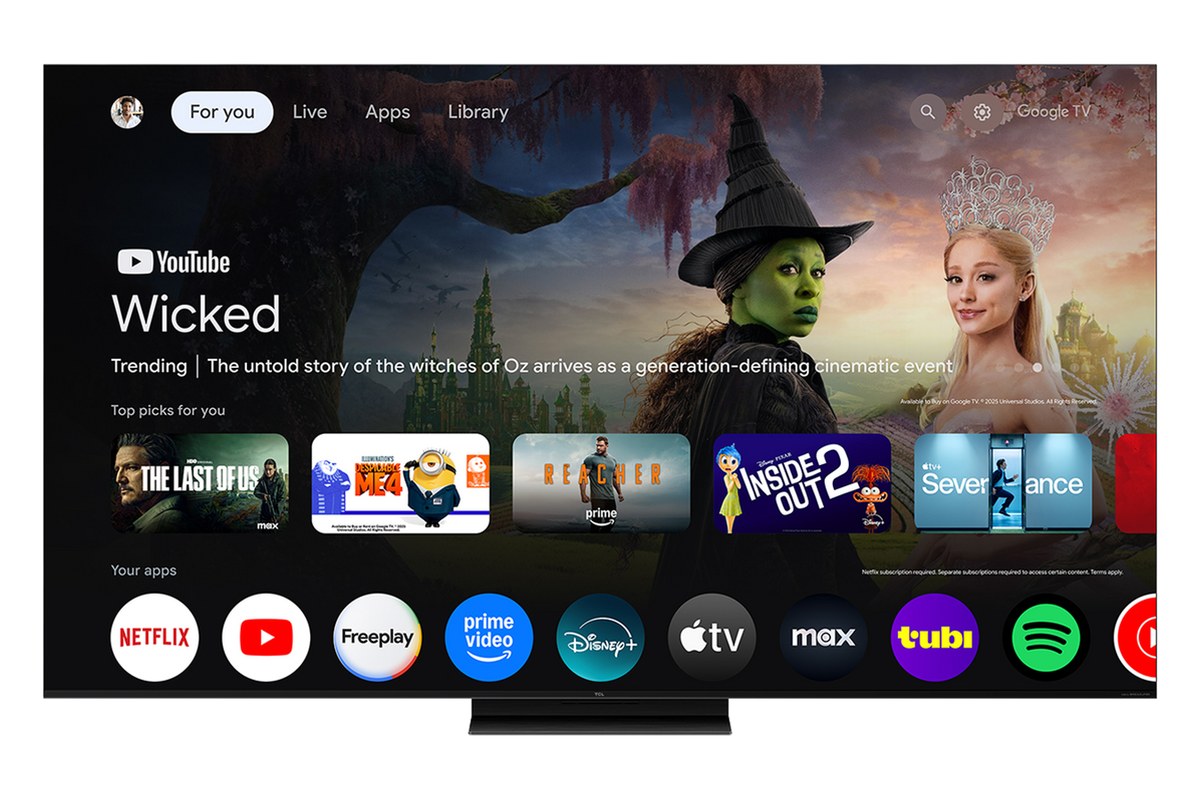
Google TV runs the show, and Gemini answers hands-free; in Digital Trends’ testing it also changed picture and sound settings by voice. TechRadar found Gemini sometimes wrong about where to stream a film. As on almost every smart TV, the home screen carries ads you can’t switch off, though RTINGS notes a Basic TV mode removes them along with most smart features. Chromecast is built in. Connectivity is a step behind the QM8L: TCL lists Wi-Fi 5 rather than Wi-Fi 6, and the ATSC 1.0 tuner can’t receive NextGen TV (ATSC 3.0) broadcasts.
The 65-inch is 2.2 inches deep and weighs 39.7 pounds without its stand. It sits on a center pedestal about 15 inches wide, which fits narrow furniture and can be fitted at two heights during setup to clear a soundbar, and a removable back cover tidies the cables. The remote is backlit but drops the brightness rocker of the QM8L’s remote, and the build leans on plastic, which Digital Trends calls expected at this price.
How Does It Stack Up Against the Competition?
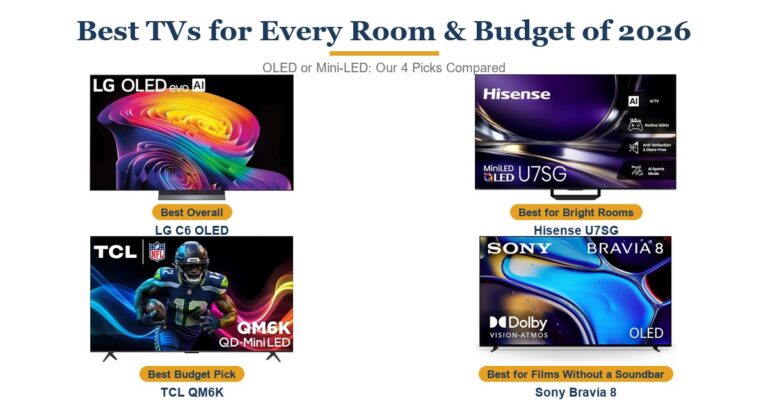
TCL’s own QM8L is the step up, Hisense’s U7SG is the closest Mini-LED rival, and LG’s B6 is the entry-level OLED alternative. Here’s how the 65-inch models compare.
| Feature | TCL QM7L | TCL QM8L | Hisense U7SG | LG B6 OLED TV |
|---|---|---|---|---|
| Price (USD) | $849.99 (65") | $997.99 (65") | $797.99 (65") | $1,199.99 |
| Display type | SQD-Mini LED | SQD-Mini LED | Mini-LED | OLED, pixel dimming |
| Native refresh rate | 144Hz | 144Hz | 165Hz | 120Hz |
| HDMI inputs | 4, two at 4K 144Hz | 4, all 4K 144Hz | 4, all HDMI 2.1 | 4, all 4K 120Hz |
| HDR formats | Dolby Vision IQ, HDR10, HDR10+, HLG | Dolby Vision IQ, HDR10, HDR10+, HLG | Dolby Vision IQ, HDR10, HDR10+, HLG | Dolby Vision, HDR10, HLG |
| Built-in audio | 2.2-channel, Audio by Bang & Olufsen | Audio by Bang & Olufsen | 2.1.2-channel, 50W, with subwoofer | 2.0-channel, down-firing |
| Wi-Fi | Wi-Fi 5 | Wi-Fi 6 | Wi-Fi 6E | Wi-Fi 5 |
| Smart platform | Google TV | Google TV | Google TV | webOS 26 |
| TTP Review | This review ↑ | Read our review → | Read our review → | Read our review → |
| Amazon | View on Amazon | View on Amazon | View on Amazon | View on Amazon |
Prices change frequently — always verify current pricing before purchasing.
The QM8L uses the same SQD color but adds a brighter panel with roughly twice the dimming zones, four full-speed HDMI 2.1 ports, Wi-Fi 6 and an ATSC 3.0 tuner. TechRadar calls it only a tiny bit better a TV, and as of November 2026 it cost more than the QM7L on Amazon.
The head-to-head tests split on Hisense’s U7SG. Tom’s Guide’s head-to-head prefers the QM7L for its punchier color and tighter contrast while measuring higher HDR brightness on the Hisense, though its separate U7SG review saw nearly identical color on the two. RTINGS rates the U7SG a bit better overall: it offers better color accuracy out of the box, upscales low-quality video better, tracks HDR brightness more faithfully and shows clearer motion. It also runs all four HDMI ports at HDMI 2.1 speed, up to 165Hz, and has a 2.1.2-channel speaker system with a built-in subwoofer, which Tom’s Guide found sounds better. We review it separately.
LG’s B6 is the dark-room choice. RTINGS compared the QM7L with the B6E, which TechRadar says performs the same as the B6 apart from a few AI picture modes. RTINGS found the LG’s near-infinite contrast produces far deeper, more even blacks without halos around bright objects or subtitles, while the TCL is considerably brighter and copes better with daytime glare.
TCL QM7L: Worth It for Rich Color and Bright HDR at a Mid-Range Price
Buy the QM7L if you want most of TCL’s premium picture without paying for the QM8L. It gets bright enough for a sunny room, keeps blacks deep for movie nights and matches the QM8L’s color range, with low input lag for a console on top. As of November 2026 its regular Amazon price sat a little above Hisense’s U7SG and below the QM8L.
Look elsewhere in three cases. If you need more than two fast HDMI inputs for consoles and a gaming PC, the QM8L or the U7SG gives you four. If lamps or windows sit right across from the screen, RTINGS’ tests favor the U7SG’s matte coating. And if you mostly watch in a dark room and want deeper blacks with no halos, LG’s B6 OLED delivers them, at the cost of brightness.
Sources
- TCL — QM7L Series (65QM7L) specifications
- TCL — QM8L and QM7L launch announcement
- TCL QM7L (65-inch) — Amazon Product Listing
- RTINGS — TCL QM7L TV Review
- RTINGS — Hisense U7SG vs TCL QM7L
- RTINGS — LG B6E OLED vs TCL QM7L
- Tom’s Guide — TCL QM7L review
- Tom’s Guide — Hisense U7SG vs TCL QM7L
- TechRadar — TCL QM7L review
- TechRadar — TCL’s mid-range Mini-LED against LG’s most affordable OLED
- Digital Trends — TCL QM7L review
- CGMagazine — TCL QM7L SQD Mini LED 65 Inch TV review
- TCL — QM8L Series (65QM8L) specifications
- Hisense Canada — 65U7SG specification sheet
- LG — 65-inch B6 OLED (OLED65B6GUA) specifications
Reader Poll
Which TCL QM7L trade-off would matter most in your room?
Help Our Editors Know What Matters to You
Explore on Amazon →