Best Portable Air Conditioners for Summer 2026: 3 Top Picks Compared
From Consumer Reports’ top-scoring inverter model to a budget-friendly workhorse, here’s which portable AC actually fits your room and your electricity bill this summer.

How We Researched
3 portable air conditioners considered, drawing on Consumer Reports’ 2026 testing, independent lab measurements from ConsumerAnalysis.com, and verified manufacturer specifications. No manufacturer paid for placement — badges and scores reflect editorial judgment only.
What You’ll Learn
- Hisense HAP0824TWD — Consumer Reports’ top-scoring pick for rooms up to 350 sq ft
- Midea Duo MAP14S1TBL — the most efficient option for larger rooms up to 550 sq ft
- Whynter ARC-14S — dependable cooling at the lowest price of the three
- Why dual-hose and inverter compressors matter more than the BTU number on the box
- How to match coverage area to your actual room size
Shopping for the best portable air conditioner in 2026 means looking past the inflated ASHRAE BTU number printed on the box and focusing on three things that actually determine comfort: hose configuration, compressor type, and real seasonally-adjusted cooling capacity (SACC). We compared three dual-hose models that span the price range — from Consumer Reports’ top-tested pick to a budget-friendly veteran — to help you match the right unit to your room and your budget.
1. Hisense HAP0824TWD — Best Overall
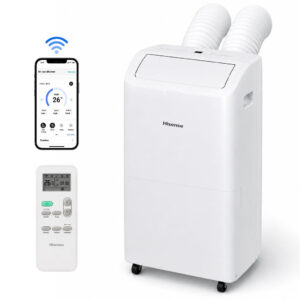
Consumer Reports named the HAP0824TWD the highest-scoring portable air conditioner in its 2026 testing, and the inverter compressor is the reason why. Instead of switching fully on and off like most budget units, it ramps speed up and down to hold a steady room temperature — testers credited it with the fastest time-to-target-temperature in the group. Its dual-hose design also avoids the negative-pressure problem that lets single-hose units pull warm air back into the room.
At 8,000 BTU DOE/SACC, it’s sized for rooms up to about 350 square feet — a bedroom or home office, not an open-concept living space. Consumer Reports also gave it a perfect score for staying efficient through brownouts and voltage drops, a real advantage during a heat-wave grid crunch, and its 42 dB(A) Quiet mode is genuinely low enough to sleep next to.
Best for: bedrooms and home offices up to 350 sq ft where you want the strongest tested performance and don’t mind paying a premium for it.
2. Midea Duo MAP14S1TBL — Best for Large Rooms
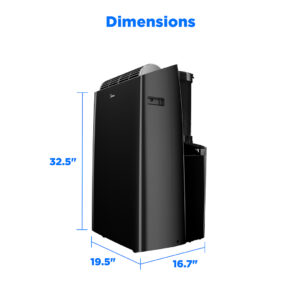
If your space is bigger than a bedroom, the Duo is the pick to beat. Independent testing from ConsumerAnalysis.com measured a SACC/watt ratio of 9.2 for the Duo — the strongest efficiency number among the 14,000 ASHRAE BTU models it tested, none of which included an inverter compressor at all. At 12,000 SACC BTU, it also had the highest real-world cooling capacity of that group, covering rooms up to 550 square feet.
The trade-off is size and price: at nearly 75 pounds it’s the heaviest of the three, and it costs more upfront than either the Hisense or the Whynter. ConsumerAnalysis.com also found it “just as loud as competitors” once you move past the lowest fan speed, so the 42 dB(A) quiet rating is a best-case number rather than what you’ll hear cooling a room down on a 95-degree afternoon.
Best for: larger bedrooms, open living spaces, or anyone running a portable AC all summer who wants the lowest long-term electricity cost.
3. Whynter ARC-14S — Best Budget Pick
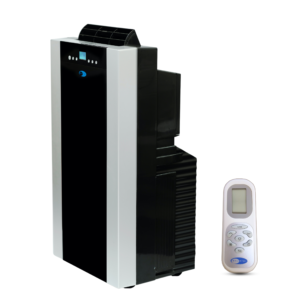
The ARC-14S skips the inverter compressor and Wi-Fi app that push up the price on the Hisense and Midea, and in exchange it’s the most affordable of the three. Good Housekeeping named it a 2025 top pick in the category, and it’s been an Amazon bestseller for years — a track record that counts for something in a category full of unfamiliar brand names.
ConsumerAnalysis.com measured its real SACC cooling capacity at 9,500 BTU (against a 14,000 BTU ASHRAE rating on the box) and a SACC/watt efficiency ratio of 7.1 — noticeably behind the Midea Duo’s 9.2, so expect a higher electricity bill if you run it constantly through a hot summer. It also skips Wi-Fi entirely, relying on a physical remote and onboard panel instead.
Best for: budget-conscious buyers who want reliable dual-hose cooling for a room up to 500 sq ft and don’t need smart controls or the last word in efficiency.
Quick Comparison
| Hisense HAP0824TWD | Midea Duo MAP14S1TBL | Whynter ARC-14S | |
|---|---|---|---|
| Price (USD, approx.) | $499 | $579.99 | $499.99 |
| Cooling (SACC) | 8,000 BTU | 12,000 BTU | 9,500 BTU |
| Coverage Area | Up to 350 sq ft | Up to 550 sq ft | Up to 500 sq ft |
| Hose Type | Dual hose | Dual hose | Dual hose |
| Compressor | Inverter | Inverter | Fixed-speed |
| Wi-Fi / App | Yes | Yes | No |
| Quiet-mode Noise | 42 dB(A) | 42 dB(A) | 51 dB(A) |
| Weight | ~60 lbs | ~75 lbs | ~80 lbs |
| Our Score | 4.4/5 | 4.3/5 | 3.7/5 |
Prices current as of July 2026 — verify before purchasing.
The Final Word
There’s no single “best” portable AC — there’s the best one for your room size and how you actually use it. If you want the strongest tested performance in a bedroom or office and don’t mind paying for it, the Hisense HAP0824TWD is the one to beat. If your space is bigger or you’re running the unit non-stop through a heat wave, the Midea Duo’s efficiency edge pays for itself over a full summer. And if you just want dependable cooling without the smart-home extras, the Whynter ARC-14S has earned its long track record honestly.
Browse all Home & Garden reviews →Home & Garden reviews → for more seasonal picks.
Frequently Asked Questions
Do I really need a dual-hose portable air conditioner?
What size portable AC do I need for my room?
Is an inverter compressor worth paying more for?
Are portable air conditioners as effective as window units?
Do these portable ACs need to be vented outside?