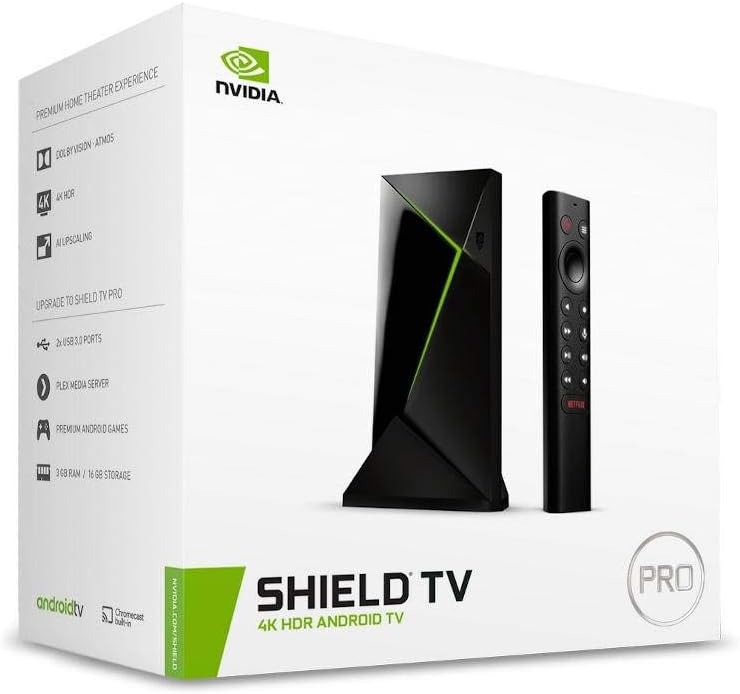
Buy it when it's back in stock if your streamer also has to be your Plex server: the Shield TV Pro runs Plex Media Server itself, passes lossless Dolby TrueHD and DTS-HD audio to a receiver, and has two USB 3.0 ports and gigabit Ethernet for big drives. Most testers found its AI upscaling makes HD video look sharper on a 4K TV. The trade-off is age: it lacks AV1 and HDR10+, and YouTube plays without HDR. If you mostly stream apps, the Google TV Streamer fits better.
Pros
- Runs Plex Media Server on the box itself
- Passes lossless Dolby TrueHD and DTS-HD audio
- AI upscaling sharpens HD video on 4K TVs
- Two USB 3.0 ports and gigabit Ethernet
- Still getting software updates (February 2026)
Cons
- No AV1 or HDR10+; no HDR on YouTube
- Only 16 GB of storage; big Plex transcodes can need more
- No game controller in the box
- Out of stock new on Amazon (October 2026)
As an Amazon Associate I earn from qualifying purchases. Disclosure
Overview
Seven years after launch, the NVIDIA Shield TV Pro is still a streamer built for home theaters more than for casual viewing. It’s a 2019 box built on NVIDIA’s Tegra X1+, a chip from the same family as the Nintendo Switch’s, and it doubles as a Plex Media Server, a cloud-gaming console and an AI upscaler for HD video. It’s for people who keep their own movie files, run a surround receiver or want GeForce Now on the TV, more than for anyone who only opens Netflix.
This review comes at an odd moment. On October 2, 2026, NVIDIA said it had stopped making the base Shield TV and raised its price for the Pro by $100, citing the rising cost of components, including memory, and said it is now focusing production on the Pro. As of October 2026 the Pro is out of stock new on Amazon.
Key Specifications
| Price (USD) | $199.00 |
| Processor and memory | NVIDIA Tegra X1+ with a 256-core GPU; 3 GB RAM |
| Storage | 16 GB (part used by the system), expandable with USB drives |
| Video | 4K HDR at 60 fps; Dolby Vision and HDR10; AI-enhanced upscaling |
| Audio | Dolby Atmos; Dolby TrueHD, DTS-HD and DTS:X passthrough over HDMI |
| Ports | HDMI 2.0b (HDCP 2.2, CEC), two USB 3.0 Type-A, Gigabit Ethernet |
| Wireless | Wi-Fi 5 (802.11ac, 2×2 MIMO, 2.4 and 5 GHz); Bluetooth 5.0 |
| Software | Android 11 (Android TV) with Chromecast built in; SHIELD Experience 9.2.4 (February 2026) |
| Remote | Voice microphone, motion-activated backlit buttons, IR blaster for TV and soundbar power and volume, remote locator, 2 AAA batteries |
| Size and weight | 6.26 x 3.86 x 1.02 in; 8.8 oz |
| Power | 40 W adapter; 5 to 10 W typical use |
NVIDIA Shield TV Pro Picture and Sound
For movies, the Shield’s strength is how much it can pass to a good system intact. It plays 4K HDR at 60 frames per second in Dolby Vision and HDR10, supports Dolby Atmos, and passes lossless Dolby TrueHD and DTS-HD, plus DTS:X, through to an AV receiver. Android Police’s reviewer, who keeps Blu-ray rips on a Plex server, found the Shield the only device that reliably played everything without transcoding.
The AI upscaler arrived with the 2019 models. It works on video up to 1080p, a 2020 software update (SHIELD Experience 8.2) extended it to 60 fps content such as live sports on the 2019 Pro, and a demo slider lets you compare it with standard upscaling on screen. Most reviews of the Pro found it sharpens 1080p and older video visibly on a 4K TV. TechRadar, which praised it, found it can occasionally be overly aggressive on scenes meant to look soft; Tom’s Guide, testing the base 2019 Shield TV, which shares the Pro’s chip and video features, was less taken and stopped noticing the difference once a show was under way.
The gaps come from the age of the hardware. The Shield lacks AV1 decoding and Samsung’s HDR10+ format, and YouTube doesn’t play in HDR on it: 9to5Google blames the missing AV1, while NVIDIA’s Andrew Bell named better VP9 support as what a successor would need for YouTube HDR. Its HDMI port is version 2.0b (4K at up to 60 Hz), where every rival in the table below has HDMI 2.1, though BGR finds 2.0b enough for most AV setups. Android Police found it seemed slow to switch Dolby Vision’s per-shot HDR settings on some content, not all, which can make brightness shifts distracting.
Plex, Storage and Ports
This is the Shield’s main reason to exist in 2026. It comes with Plex Media Server installed, so the box under the TV can also serve your film library to phones, tablets and other TVs, and its two USB 3.0 ports and gigabit Ethernet make it practical to hang a large drive off it. No other streaming box runs a Plex server on the device itself.
In practice, plan on adding storage. Plex says some very large, high-bitrate files need more temporary space than a 16 GB Shield has, so they can fail to play by default; for the 16 GB models its advice is a USB drive set up as adoptable storage, which Android then counts as internal, moving the server’s data to a larger drive, or switching off video preview thumbnails. Hardware acceleration covers H.264, HEVC and MPEG-2 sources, while other formats transcode with reduced performance, and files whose subtitles must be burned in are transcoded by the processor, which Plex says may be slower.
Gaming, Software and the Remote
Gaming is the other half of the pitch. The GeForce Now app streams PC games you own on Steam and other stores from NVIDIA’s servers, the Play Store has Android TV games, and the box runs emulators for older consoles if you supply the games. No controller comes in the box, but Xbox and PlayStation pads pair with it over Bluetooth.
The software is old but still maintained. The Shield runs Android 11 with Chromecast built in, three versions behind the Android 14 the Google TV Streamer shipped with, yet NVIDIA released SHIELD Experience 9.2.4 in February 2026 with January 2026 security patches. In a February 2026 interview, NVIDIA’s senior vice president of hardware engineering, Andrew Bell, said sales were stable and NVIDIA had no plans to end production or software support. The Android TV home screen has carried promoted content since a 2021 update.
The triangular remote has motion-activated backlit buttons, an IR blaster that runs a TV or soundbar’s power and volume, and a remote locator for finding it when it goes missing. Its large Netflix button is the common complaint, and KitGuru points out that it can’t be reassigned without a third-party app.
How Does It Stack Up Against the Competition?
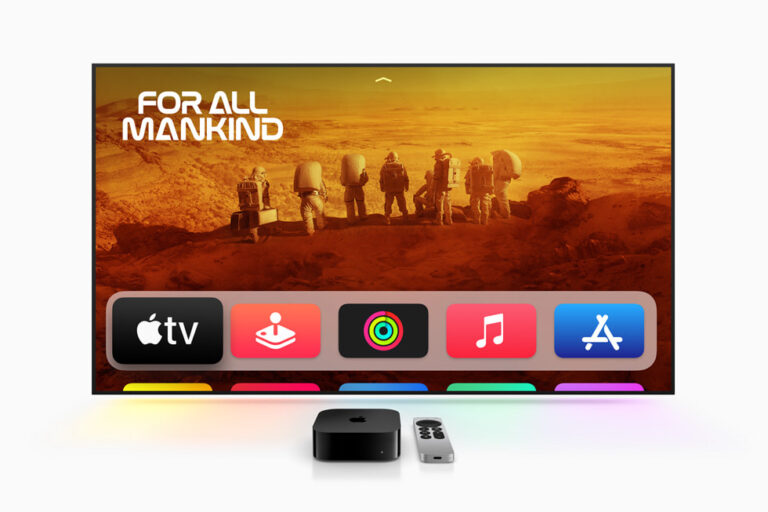
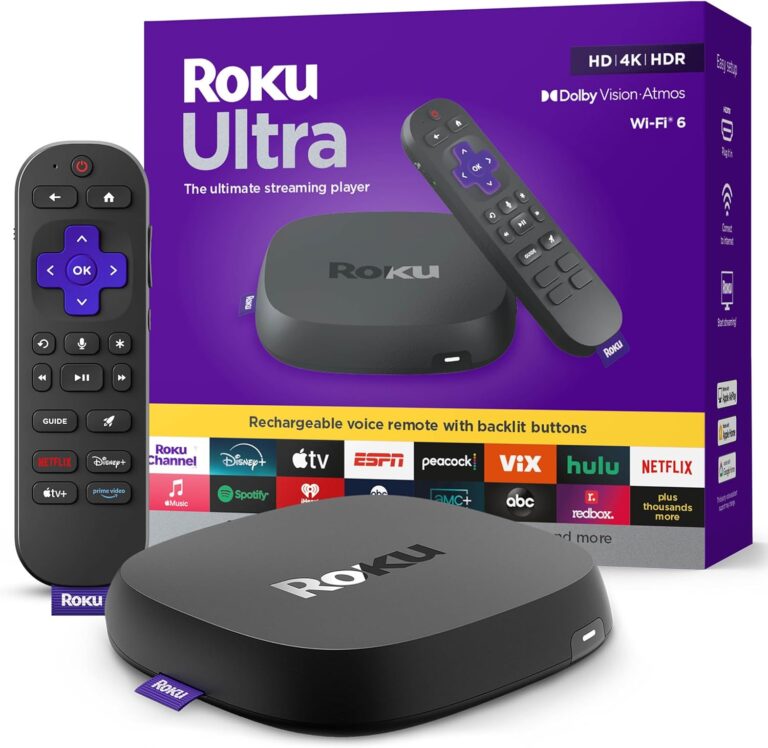
Each rival here launched in 2022 or later. What the Shield adds is two USB 3.0 ports and a Plex server built into the box.
| Feature | NVIDIA Shield TV Pro | Apple TV 4K | Google TV Streamer | Roku Ultra | Fire TV Cube |
|---|---|---|---|---|---|
| Price (USD) | $199.00 | $249.00 | See price on Amazon | $99.00 | $199.99 |
| Launched | October 2019 | October 2022 | 2024 | 2024 | October 2022 |
| Storage (maker spec) | 16 GB, plus USB drives | 128 GB | 32 GB | Not listed | 16 GB |
| HDR formats (maker spec) | Dolby Vision, HDR10 | Dolby Vision, HDR10+, HDR10, HLG | Dolby Vision, HDR10, HDR10+, HLG | Dolby Vision, HDR10, HDR10+, HLG | Dolby Vision, HDR10, HDR10+, HLG |
| HDMI | 2.0b | 2.1 | 2.1 | 2.1b | 2.1 output, plus an HDMI 2.1 input |
| Wi-Fi | Wi-Fi 5 (802.11ac) | Wi-Fi 6 (802.11ax) | Wi-Fi 5 (802.11ac) | Wi-Fi 6 (802.11ax) | Wi-Fi 6E |
| Wired Ethernet | Gigabit | Gigabit | Gigabit (10/100/1000) | 10/100 | 10/100 |
| USB | Two USB 3.0 Type-A | None listed | One USB-C (power and data) | One USB 3.0 | One USB 2.0 |
| TTP Review | This review ↑ | Read our review → | — | Read our review → | Read our review → |
| Amazon | View on Amazon | View on Amazon | View on Amazon | View on Amazon | View on Amazon |
Prices change frequently — always verify current pricing before purchasing.
NVIDIA Shield TV Pro: Worth It for Plex Servers and Home Theaters
If the box under your TV also has to be your media server, the Shield TV Pro is the one to wait for. It runs Plex Media Server itself, passes lossless surround audio to a receiver, takes USB drives at USB 3.0 speed and gives HD video a sharper look on a 4K screen. If you already own one, there’s no reason to replace it: NVIDIA shipped another update in February 2026 and has no newer model on sale. When it returns to stock, judge it against Amazon’s price on the day, since NVIDIA raised its own price in October 2026.
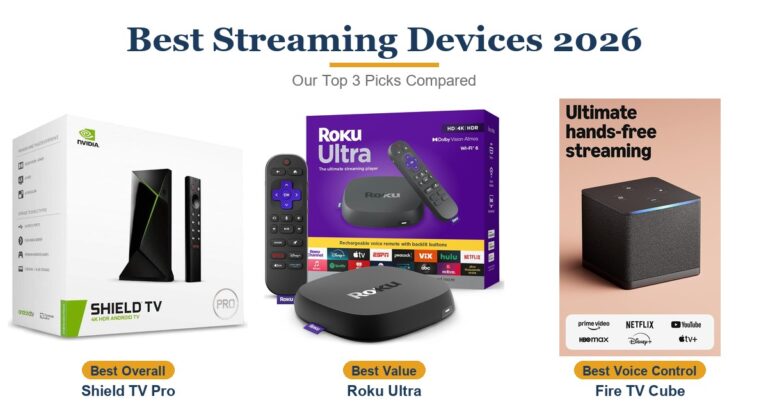
Look elsewhere if you mostly stream apps. The Google TV Streamer runs the same Android TV app library on newer software, and 9to5Google’s head-to-head found it supports AV1, which the Shield lacks; it also works as a Matter and Thread smart home hub. In an Apple household the Apple TV 4K is the natural pick, though reports point to a new model soon, so it may be worth waiting. The Fire TV Cube suits Alexa homes, with hands-free voice control and an HDMI input for a cable box.

Sources
- NVIDIA — SHIELD TV Pro Product Specifications
- NVIDIA — SHIELD Experience Upgrade 9.2.4
- NVIDIA Shield TV Pro — Amazon Product Listing
- Plex — Limitations When Running Plex Media Server on NVIDIA SHIELD
- Android Police — Nvidia Shield Pro (2019) review
- TechRadar — Nvidia Shield TV Pro review
- Expert Reviews — Nvidia Shield TV Pro (2019) review
- T3 — Nvidia Shield TV Pro review
- KitGuru — Nvidia Shield TV Pro 2019 review
- Tom’s Guide — Nvidia Shield TV (2019) review
- BGR — Is the Nvidia Shield TV Pro still worth buying in 2026?
- 9to5Google — Google TV Streamer vs Shield TV
- 9to5Google — Nvidia Shield TV Pro gets a $100 price hike
- Wccftech — NVIDIA axes the standard Shield TV and raises the Shield TV Pro’s price
- Gizmodo — Nvidia is killing its base Shield TV
- TROYPOINT — NVIDIA Shield TV Pro is sold out
- Notebookcheck — Nvidia comments on future of Nvidia Shield TV
- TweakTown — NVIDIA is working on a new Shield TV
- Android Headlines — NVIDIA Shield TV February 2026 update
- TechRadar — The base Nvidia Shield is discontinued; the Shield Pro lives on
- MacRumors — Apple TV roundup
- Apple — Apple TV 4K Technical Specifications
- Google — Google TV Streamer (4K) Tech Specs
- Roku — Roku Ultra
- Expert Reviews — Amazon Fire TV Cube (3rd generation) review
- Android Authority — Amazon Fire TV Cube (3rd gen) review
Reader Poll
What would you mainly use a Shield TV Pro for?
Help Our Editors Know What Matters to You
Explore on Amazon →