The HomePower 1000 v2 is the Jackery to get for keeping a home office and a fridge running through outages: it switches to battery in under 10 ms by Jackery's rating, guards plugged-in gear with 3kV surge protection, and Priority Routing sheds less important loads to stretch the charge. Its 6,000-cycle rating and 50-minute fast recharge suit a station that sits plugged in for years. The trade-off is its 1,500W ceiling, below what the Anker SOLIX C1000 Gen 2 and DJI Power 1000 V2 deliver from the same capacity, so anyone running high-draw appliances is better served by the DJI.
Pros
- Under-10 ms UPS switchover (Jackery rating)
- 3kV surge protection and Priority Routing
- 6,000-cycle LiFePO4 battery
- 50-minute fast recharge
- Charges down to 14°F (-10°C)
- Compact 23.4 lb build with a built-in light
Cons
- 1,500W ceiling, lower output than similar rivals
- Fixed capacity; solar input tops out at 400W
- Dated, low-resolution screen
- 5-year warranty only when bought from Jackery
As an Amazon Associate I earn from qualifying purchases. Disclosure
Overview
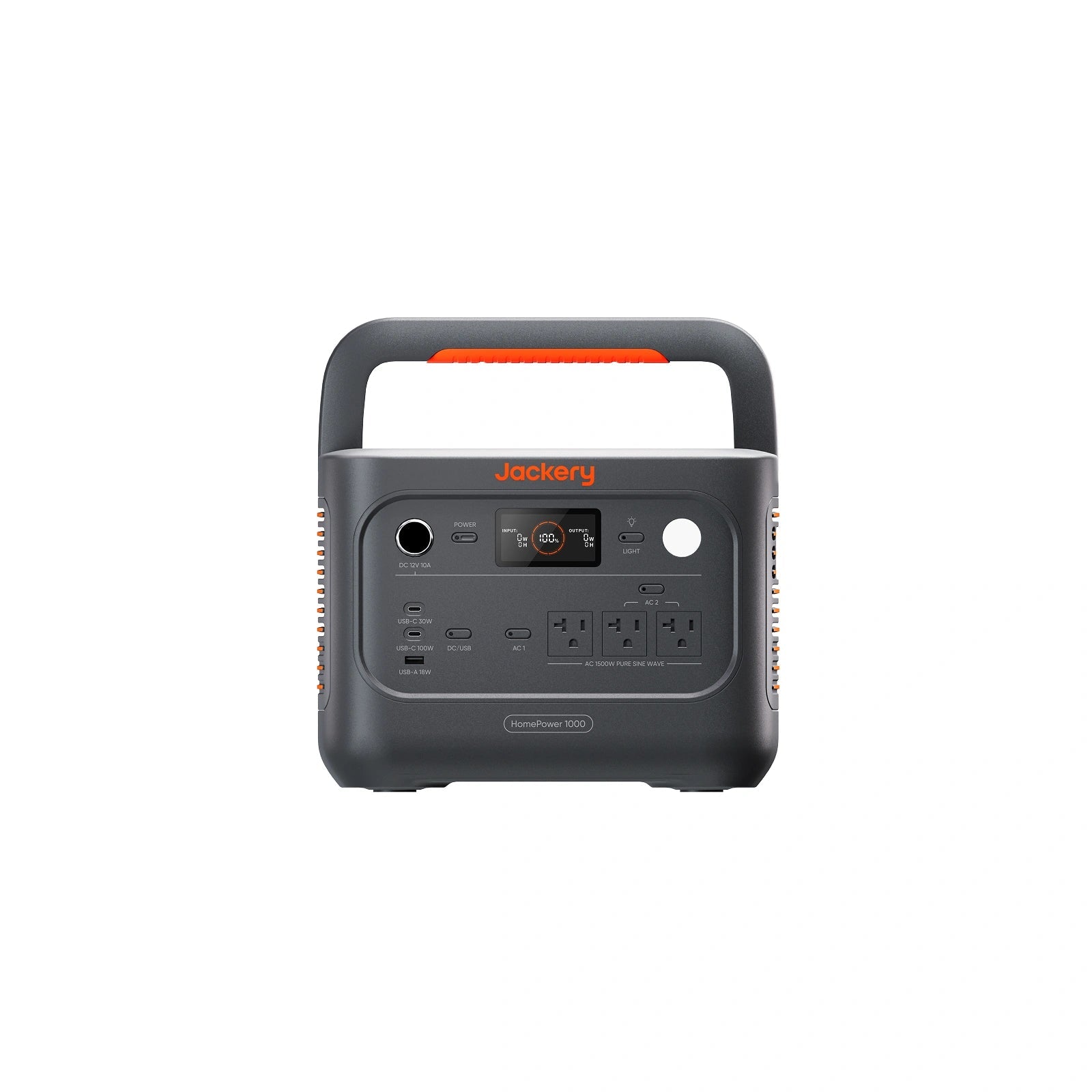
Jackery pitches its Explorer 1000 v2 at campers and RV travelers who carry their power around. The Jackery HomePower 1000 v2 flips that order: it is a 1,024Wh lithium iron phosphate (LiFePO4) battery with a 1,500W inverter, built to sit plugged in beside a desk, a router or a fridge and take over the moment the grid drops. Jackery rates the switch to battery at under 10 ms and adds 3kV surge protection and a Priority Routing mode that sheds less important loads as the charge runs down.
It sits beside Jackery’s Explorer 1000 v2 rather than replacing it, and the two are close in size and capacity. What the HomePower adds is home-backup hardware: Jackery rates its switchover at under 10 ms against the Explorer’s 20 ms, its cells at 6,000 cycles to 70% capacity against 4,000, and its fastest wall charge at 50 minutes against an hour. It can also charge in the cold down to 14°F (-10°C), where the Explorer stops at freezing. The Explorer keeps a slightly larger 1,070Wh battery at about the same weight.
Key Specifications
| Price (USD) | $499.00 |
| Capacity | 1,024Wh, LiFePO4 cells (not expandable) |
| AC output | 1,500W rated, 3,000W peak |
| AC and USB outputs | 3 AC outlets (120V), 1 USB-C (100W), 1 USB-C (30W), 1 USB-A (18W) |
| UPS switchover | Under 10 ms (Jackery rating) |
| Protection | 3kV surge resistance and lightning protection; Priority Routing load shedding |
| AC charging | 50 minutes with Emergency Fast Charge; draws up to 15A |
| Other charging | Solar 400W max (3.3 hours); DC-DC alternator charger 600W (2.7 hours); car charging supported |
| Battery rating | 6,000 cycles to 70%+ capacity |
| Noise | Under 30dB (Jackery rating) |
| Weight | About 23.4 lb (10.6 kg) |
| Dimensions | 12.4 × 7.9 × 9.2 in (31.4 × 20.1 × 23.4 cm) |
| Operating temperature | Charging and discharging 14°F to 113°F (-10°C to 45°C) |
| Warranty | 3 years; 2 more years added automatically on jackery.com purchases |
Jackery HomePower 1000 v2 Backup and UPS Features
Left plugged into the wall with your devices connected through it, the HomePower works like a large uninterruptible power supply. The under-10 ms switchover is Jackery’s rating, and the hands-on reviews so far repeat it rather than measure it, so treat it as the maker’s figure. Jackery says it is fast enough that a desktop PC won’t restart when the grid drops.
Two features set it apart from the Explorer 1000 v2 and Explorer 1000 Plus. Priority Routing lets you pick which devices matter most and a battery level; when the charge falls to that level, the station switches off the less important loads so the fridge or router keeps going longer. The built-in 3kV surge resistance and lightning protection guard what is plugged in against spikes when power returns or a storm hits nearby.
How long it lasts depends on the load. Jackery estimates about 4 hours for a 200W refrigerator or a 200W desktop PC and about 34 hours for a 10W Wi-Fi router. In CleanTechnica’s road test it kept a large fridge running for hours, locked in a truck bed through days of 100°F-plus heat, and it had no trouble with repeated charging and discharging. Misfit Printing ran one of its largest 3D printers from it without problems.
Output and Capacity
The 1,500W continuous rating (3,000W peak) covers most electronics and many household appliances, and CleanTechnica found it could briefly go past that rating: a heat gun and a Vitamix blender together drew 2,125W for a few seconds without tripping it. At that kind of draw, CleanTechnica noted, the battery would be empty in about 28 minutes. Misfit Printing adds that hair dryers and microwaves will likely drain it fast.
That 1,500W ceiling is the HomePower’s main trade-off: the Anker SOLIX C1000 Gen 2 is rated at 2,000W and the DJI Power 1000 V2 at 2,600W from the same 1,024Wh of storage, so either leaves more room for high-draw appliances. The capacity is fixed, too: there is no port for an add-on battery. Jackery’s HomePower 1000 Plus v2 is the expandable sibling, growing from 1,024Wh to 11kWh with an 1,800W output.
Charging Speed and Solar Input
Recharging is quick when you need it. Jackery rates its Emergency Fast Charge at 50 minutes from the wall, and CleanTechnica notes it pulls up to 1,600W (15 amps at 120V) to do it. In everyday charging, Misfit Printing found that a full charge took about an hour and a half. That speed matters most when a storm warning gives you a short window to top it up.
Solar input tops out at 400W, which Jackery rates at 3.3 hours for a full charge from two of its 200W panels. That is less than the Anker’s 600W, and DroneXL notes the DJI needs an external controller for high-power solar charging. A 600W DC-DC alternator charger (2.7 hours, by Jackery’s rating) and car charging cover vehicle use.
It also charges in colder conditions than the Explorer 1000 v2, the Anker and the DJI. Jackery rates charging from 14°F to 113°F (-10°C to 45°C), while those three stop charging below freezing, so it can still top up in a cold garage on a day when they can’t. Below 14°F (-10°C) it neither charges nor powers devices, by the same rating.
Size, Screen and Everyday Use
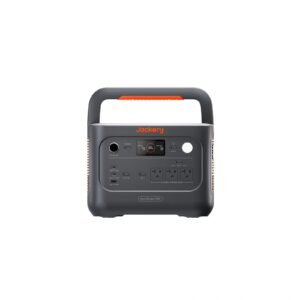
Compact for a 1kWh station at about 23.4 lb and 12.4 × 7.9 × 9.2 inches, it is a box you can move to whichever room loses power, and iPhone in Canada’s reviewer carried it one-handed without trouble.
The one thing iPhone in Canada’s reviewer disliked was the screen, a “fairly low resolution” LCD that shows the charge and the watts going in and out but looks dated beside newer rivals. Jackery rates the noise at under 30dB in Quiet Mode, low enough for a bedroom or office, though no independent noise reading has been published yet. The app adds control from a phone.
The 6,000-cycle rating works out, by Jackery’s count, to more than 16 years of daily cycles before capacity falls to 70%. The warranty is 3 years, and Jackery adds 2 more automatically only when you buy from its own store, so an Amazon purchase carries the 3-year term.
How Does It Stack Up Against the Competition?
All four are current 1,024Wh LiFePO4 stations with a UPS mode. The figures are each maker’s ratings, except the DJI’s switchover time and solar note, which come from DroneXL’s review.
| Feature | Jackery HomePower 1000 v2 | Anker SOLIX C1000 Gen 2 | DJI Power 1000 V2 | BLUETTI Elite 100 V2 |
|---|---|---|---|---|
| Price (USD) | $499.00 | $529.99 | $469.99 (Oct 30) | $499.00 |
| Capacity | 1,024Wh | 1,024Wh | 1,024Wh | 1,024Wh |
| Continuous AC output | 1,500W | 2,000W | 2,600W | 1,800W |
| UPS switchover | Under 10 ms | Under 10 ms | 10 ms | 10 ms or less |
| Fastest AC recharge | Full in 50 min | Full in 49 min | Full in 56 min | 0-80% in 45 min |
| Max solar input | 400W | 600W | High-power solar needs an external controller | 1,000W |
| Battery rating | 6,000 cycles to 70% | 4,000 cycles to 80% | 4,000 cycles to 80% | 4,000+ cycles to 80% |
| Lowest charging temperature | 14°F (-10°C) | 32°F (0°C) | 32°F (0°C) | Not listed by BLUETTI |
| Noise rating | Under 30dB | 20dB | 26dB | 30dB |
| Weight | About 23.4 lb | 24.9 lb | About 31.3 lb (14.2 kg) | 25 lb (11.5 kg) |
| TTP Review | This review ↑ | Read our review → | — | — |
| Amazon | View on Amazon | View on Amazon | View on Amazon | View on Amazon |
Prices change frequently — always verify current pricing before purchasing.
Jackery HomePower 1000 v2: Worth It for Outage-Proofing a Home Office
If the job is keeping a desktop PC, monitor, modem and router running through a cut without a reboot, then holding a fridge or freezer for a few hours, this is the Jackery to buy. The fast switchover, surge protection and Priority Routing are aimed at exactly that, the long cycle rating suits a station that sits plugged in for years, and it is light enough to carry to wherever the outage hurts most. Buy it from Jackery’s own store if the extra two years of warranty matter to you.
Look elsewhere for heavier loads or room to grow. The Anker SOLIX C1000 Gen 2 (2,000W) and DJI Power 1000 V2 (2,600W) cover appliances above the 1,500W limit, the DJI and Jackery’s HomePower 1000 Plus v2 both take add-on batteries, and the Anker and the BLUETTI Elite 100 V2 accept more solar. For camping, the Explorer 1000 v2 does the same 1,500W job with a slightly bigger battery.
Sources
- Jackery — HomePower 1000 v2 Series
- Jackery — HomePower 1000 v2 vs. Explorer 1000 Plus vs. Explorer 1000 v2
- Jackery — What Can the HomePower 1000 v2 Run?
- Jackery HomePower 1000 v2 — Amazon Product Listing
- CleanTechnica — The Jackery HomePower H1000 v2, CleanTechnica Tested
- iPhone in Canada — Jackery HomePower 1000 v2 and 2000 Plus v2 Hands-On
- Misfit Printing — Jackery Home Power 1000 V2 Review
- Anker — SOLIX C1000 Gen 2 Specifications
- DJI — Power 1000 V2 Specifications
- DJI — Power 1000 V2
- DroneXL — DJI Power 1000 V2 Review
- BLUETTI — Elite 100 V2 Specifications
Reader Poll
What would you keep running first on the HomePower 1000 v2 in an outage?
Help Our Editors Know What Matters to You
Explore on Amazon →