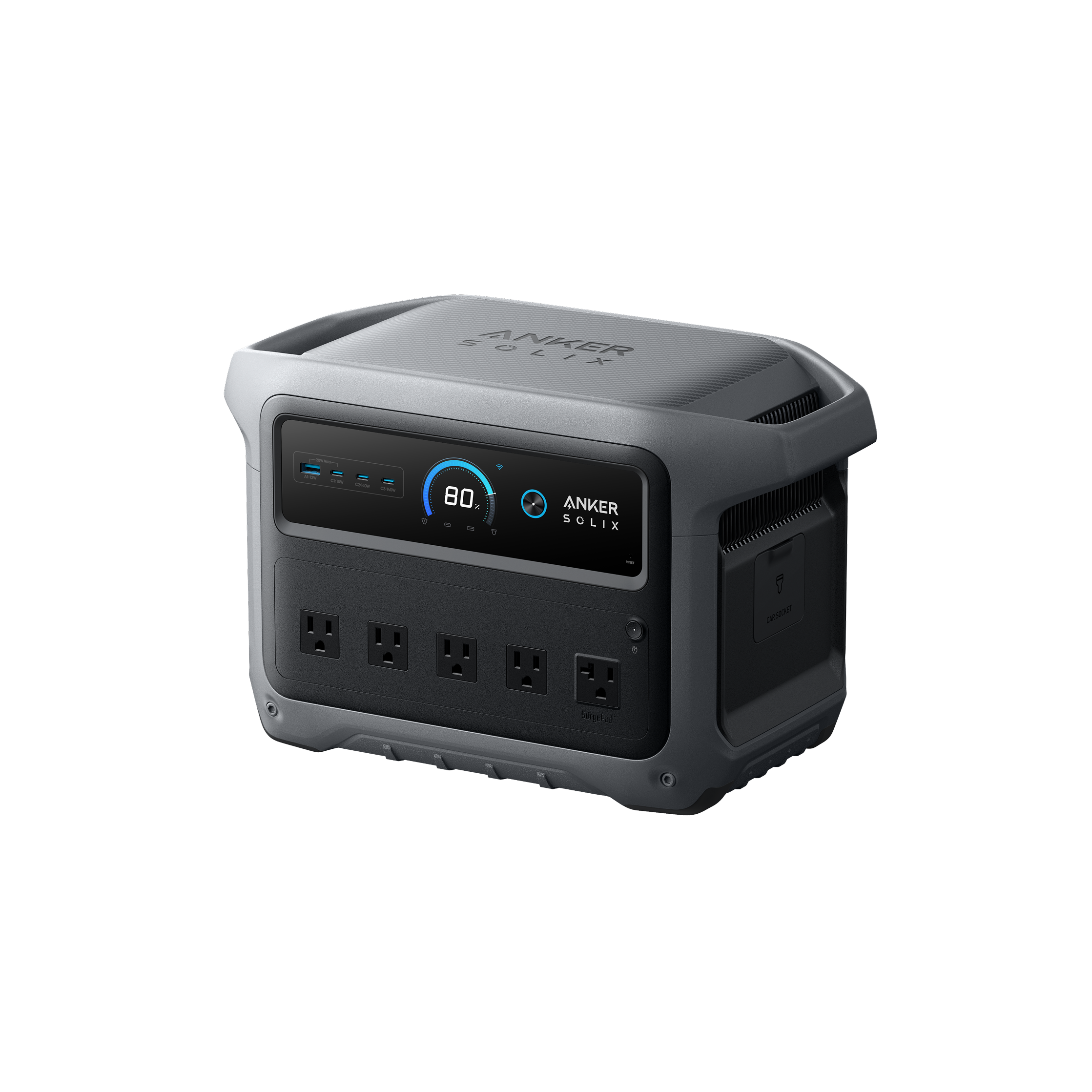
Pick the C1000 Gen 2 if you want one battery for home backup and camping that refills from a wall outlet in under an hour in its fast mode; on Amazon.ca it is sold by Anker's own Canadian storefront. Its 2,000W inverter and under-10 ms backup switchover handle kitchen appliances, a fridge or a CPAP without fuss. The trade-off is fixed capacity: it takes no extra battery, so anyone planning to grow their setup should look at the EcoFlow DELTA 3.
Pros
- Full wall recharge in about 49 minutes with UltraFast
- 2,000W continuous, 3,000W peak output
- Under-10 ms UPS switchover for CPAPs and routers
- LFP cells rated for 4,000 cycles to 80%
- Five AC outlets plus two 140W USB-C ports
Cons
- No extra battery support, unlike the original C1000
- Noisy fans at heavy loads and during fast charging
- No built-in light
- Fast mode needs cells above 20°C (68°F)
As an Amazon Associate I earn from qualifying purchases. Disclosure
Overview
A power outage rarely gives you a day’s warning, and the Anker SOLIX C1000 Gen 2 is built around that problem. It is a 1,024Wh lithium iron phosphate (LFP) power station with a 2,000W inverter, and with its UltraFast mode switched on in the Anker app it refills from a wall outlet in 49 minutes, so an hour’s notice of a storm is enough to top it up. It is built for both home backup and camping, with road trips and running corded tools away from an outlet as other uses.
Against the original C1000 from 2023, the second generation adds 200W of continuous output, charges at up to 1,600W instead of 1,300W and halves the backup switchover time to 10 ms, and Notebookcheck’s figures put it 1.6 kg lighter. For Canadian buyers the spec that matters most in winter is its charging range: Anker rates it to charge only between 0°C and 40°C, so a unit kept in an unheated garage has to come inside before it charges. GearJunkie named it the best overall portable power station in its tested roundup, calling it “the benchmark for the 1kWh category.” Two features of the original are gone, which matters for some buyers and is covered below.
Key Specifications
| Price (CAD) | Deal $649.00 until Oct 28 |
| Model | A1763 |
| Capacity | 1,024Wh, LFP (LiFePO4) cells |
| AC output | 2,000W continuous, 3,000W peak |
| Outputs | 5 AC outlets, 2 USB-C (140W each), 1 USB-C (15W), 1 USB-A (12W), 1 car socket (120W) |
| AC charging | 1,200W standard; 1,600W UltraFast (full in 49 min, switched on in the app) |
| Solar input | 600W max (60V max); full in 1.8 hours, per Anker |
| UPS switchover | Under 10 ms |
| Battery rating | At least 80% capacity after 4,000 cycles |
| Weight | 11.3 kg (24.9 lb) |
| Dimensions | 384 × 208 × 244 mm (15.12 × 8.19 × 9.61 in) |
| Operating temperature | Discharging -20°C to 40°C (-4°F to 104°F); charging 0°C to 40°C (32°F to 104°F) |
| Warranty | 5 years |
Anker SOLIX C1000 Gen 2 Recharging Speed
Fast wall charging is the reason to choose this model over most 1kWh stations. Out of the box it charges at 1,200W; switch on UltraFast in the app and it draws 1,600W, which Anker rates as a full charge in 49 minutes. 9to5Toys reported that its unit kept close to that 49-minute pace across repeated charges with the fast mode on. Notebookcheck, testing the European version, timed just under 55 minutes without the boost mode and noticed that it was still pulling about 1,200W shortly before reaching full, the stage where other stations usually slow down.
That speed comes with two conditions from Anker itself, and the first matters in a Canadian winter. UltraFast only activates when the battery cells are above 20°C (68°F), charging between 0°C and 20°C (32°F to 68°F) is significantly slower, and Anker’s charging range stops at 0°C, while it can still discharge down to -20°C (-4°F). So in real cold it can keep powering things after it has stopped accepting a charge. Anker also advises using the fast mode only when you need it, to prolong the battery’s life, so the everyday 1,200W rate is the one to plan around. 9to5Toys gives that standard rate as about 1.5 hours for a full charge, longer than the European unit’s time above.
Notebookcheck also measured how much power went in: 1,110Wh from the wall for the 1,024Wh battery, about 92% efficiency, which it called a good value. For off-grid use, the station accepts up to 600W of solar at up to 60V, which Anker says refills it in 1.8 hours, and it can take solar and wall power at the same time, drawing on solar first.
How much the speed matters depends on how you use it. Outdoor Life’s tester puts recharge time low on the priority list, since one hour versus two rarely matters much, though that tester also valued fast-charging units when a windstorm warning arrived with several stations part-empty. It counts most when you get little warning, or when one battery has to serve a full day of camping and be ready again by morning.
Output, Ports and Runtime
The 2,000W continuous rating (3,000W peak) covers most household appliances one at a time. MacRumors ran loads up to 1,500W without issue, and GearJunkie’s field tests ran a single-pod coffeemaker and an Instant Pot. At high draw the runtime is short: MacRumors estimates a 750W to 1,500W mini heater would run for around an hour, so the station suits short bursts of heavy use and long stretches of light use.
Light use is where it lasts. MacRumors ran a MacBook Pro through a full eight-hour workday on 19% of the battery, and found the on-screen runtime estimate for a 67W MacBook Air (about 14 hours) accurate. Notebookcheck’s discharge test of the European version drew 850Wh, 83% of the rated capacity, at a steady load of about 250W, and less when the load fluctuated, a reminder that the inverter takes its share on AC; USB and the car socket skip the inverter and waste less.
MacRumors liked having all five AC outlets on the front, next to the USB ports, but warned that spacing could get tight with several large plugs; the 120W car socket sits on the side.
Portability, Noise and Everyday Use
At 11.3 kg (24.9 lb) with a handle on each side, it is easy to move from room to room or into a car, though testers differ on how far they’d carry it: MacRumors thought it probably isn’t one you’d want to lug to the beach, while GearJunkie found the lighter weight made it much more practical to take there.
The weight saving cost two features of the original. The Gen 2 has no port for an extra battery, so its 1,024Wh is fixed for life, and Anker’s own advice for anyone who needs expandable capacity is the first-generation C1000. The built-in light bar is gone too, which Notebookcheck noted you’ll miss if you planned to use the station as a lamp during an outage or at camp.
Fan noise is the other trade-off. GearJunkie credits its GaN (gallium nitride) charging hardware with producing less heat and so less fan noise, but at heavy loads two other testers still found it noisy: Notebookcheck measured 45 dB from 1 m at higher outputs and during fast charging, which it called quite audible, and MacRumors found the fans loud enough that its reviewer couldn’t have slept with them that high. Both found it much quieter at low loads, and MacRumors called it near silent when charging small devices such as phones.
The backup features are well suited to that kind of overnight duty. Plugged into the wall with a device connected, it switches to battery in under 10 ms when the power drops, fast enough for a CPAP, router or desktop. The Anker app connects over Wi-Fi or Bluetooth and sets charge and discharge limits, the charging speed and a time-of-use mode that charges at off-peak hours; Notebookcheck noted that mode works from fixed times you enter rather than linking to dynamic electricity rates. For storage, MacRumors left it switched off for a month and found it still at 100% when it came back.
The LFP cells are rated to keep at least 80% of their capacity after 4,000 cycles, and the station carries a five-year warranty.
How Does It Stack Up Against the Competition?
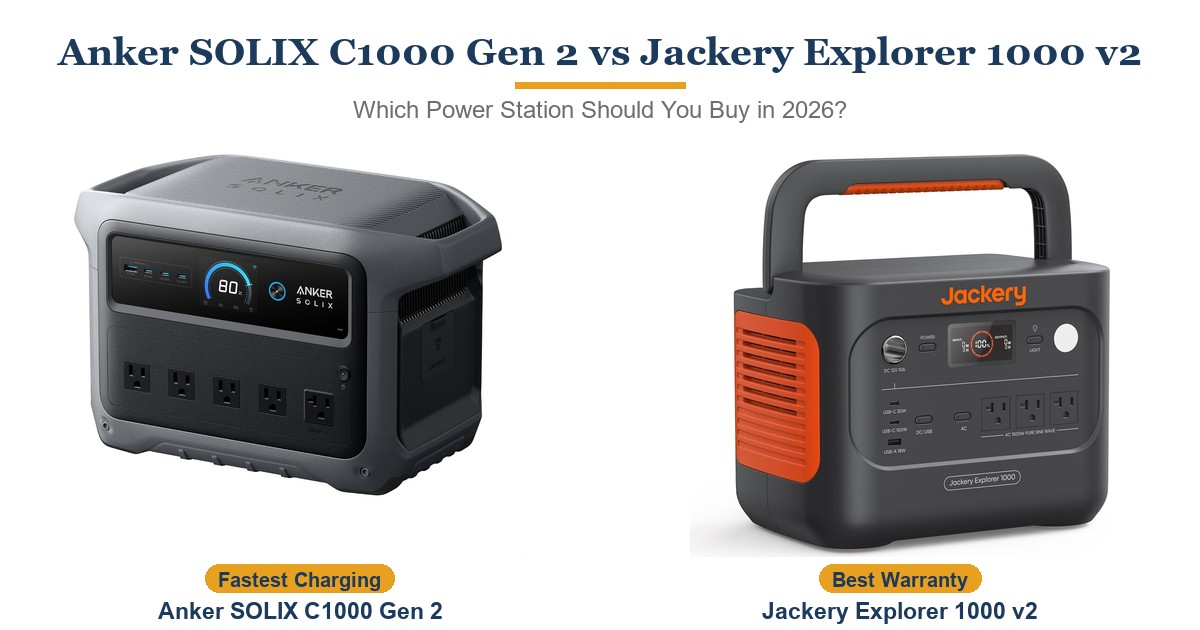
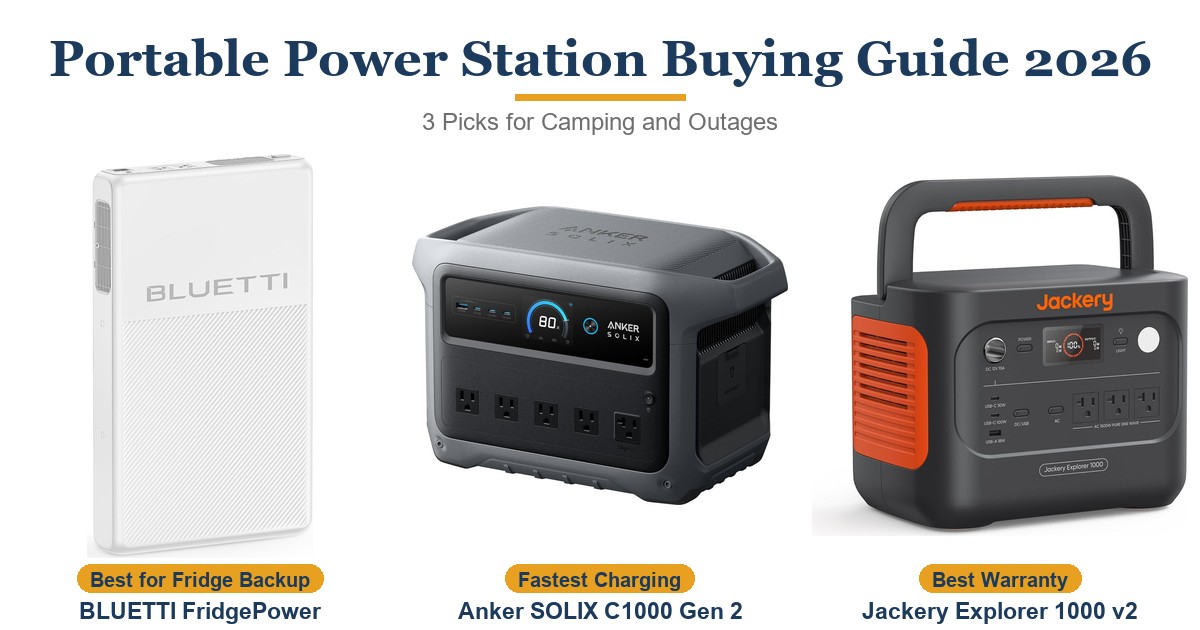
The main 1kWh rivals from EcoFlow, Jackery and BLUETTI. Specs are each maker’s own figures, and recharge times are each maker’s fastest claim, so treat them as best cases.
| Feature | Anker SOLIX C1000 Gen 2 | EcoFlow DELTA 3 | Jackery Explorer 1000 v2 | BLUETTI Elite 100 V2 |
|---|---|---|---|---|
| Price (CAD) | Deal $649.00 until Oct 28 | See price on Amazon | $649.00 | $699.00 |
| Capacity | 1,024Wh | 1,024Wh | 1,070Wh | 1,024Wh |
| Continuous AC output | 2,000W | 1,800W | 1,500W | 1,800W |
| Fastest AC recharge (maker’s claim) | 0-100% in 49 min | 0-100% in 56 min | 0-100% in 1 hour | 0-80% in 45 min (full time not listed) |
| Weight | 11.3 kg (24.9 lb) | 12.5 kg (27.6 lb) | 11.0 kg (24.2 lb) | 11.5 kg (25 lb) |
| UPS switchover | Under 10 ms | Under 10 ms | 20 ms or less | 10 ms or less |
| TTP Review | This review ↑ | — | Read our review → | — |
| Amazon | View on Amazon | View on Amazon | View on Amazon | View on Amazon |
Prices change frequently — always verify current pricing before purchasing.
Anker SOLIX C1000 Gen 2: Worth It for Backup Power That Refills Fast
The C1000 Gen 2 earns its place when turnaround matters, and in Canada that comes with a seasonal caveat: the 49-minute mode waits until the battery is above 20°C, so in a cold house during a winter outage expect the slower standard rate at first. On Amazon.ca on October 7, 2026, the Anker was $609.00 CAD for Prime members during Prime Big Deal Days, against $599.00 CAD for the Jackery Explorer 1000 v2 and $589.00 CAD for the BLUETTI Elite 100 V2, so that day the quickest full-charge claim and strongest inverter in the table cost a little more than either. As a desk or medical-device backup, the sub-10 ms switchover and the on-screen runtime readout make it easy to live with, as long as it sits where the fans won’t bother anyone during heavy use.
If you expect to want more than 1kWh later, the EcoFlow DELTA 3 takes add-on batteries up to 5kWh by EcoFlow’s figures, a path this Anker doesn’t offer. The Jackery Explorer 1000 v2 is the lightest here and holds a little more energy, at the cost of a 1,500W ceiling, and the BLUETTI Elite 100 V2 accepts up to 1,000W of solar against the Anker’s 600W, worth a look if you plan a large panel array.

Sources
- Anker SOLIX — C1000 Gen 2 Official Product Specifications
- Anker SOLIX C1000 Gen 2 — Amazon.ca Product Listing
- Notebookcheck — Anker Solix C1000 Gen 2 Power Station Review
- MacRumors — Anker Solix C1000 Gen 2 Portable Power Station Review
- 9to5Toys — Tested: Anker SOLIX C1000 Gen 2 Portable Power Station
- Techaeris — Anker SOLIX C1000 Gen 2 Review
- GearJunkie — Best Portable Power Stations
- Outdoor Life — The Best Portable Power Stations, Tested and Reviewed
- EcoFlow — DELTA 3 Portable Power Station Specifications
- Jackery — Explorer 1000 v2 Portable Power Station
- BLUETTI — Elite 100 V2 Portable Power Station
Reader Poll
What would you mainly use a 1kWh power station like this for?
Help Our Editors Know What Matters to You
Explore on Amazon →