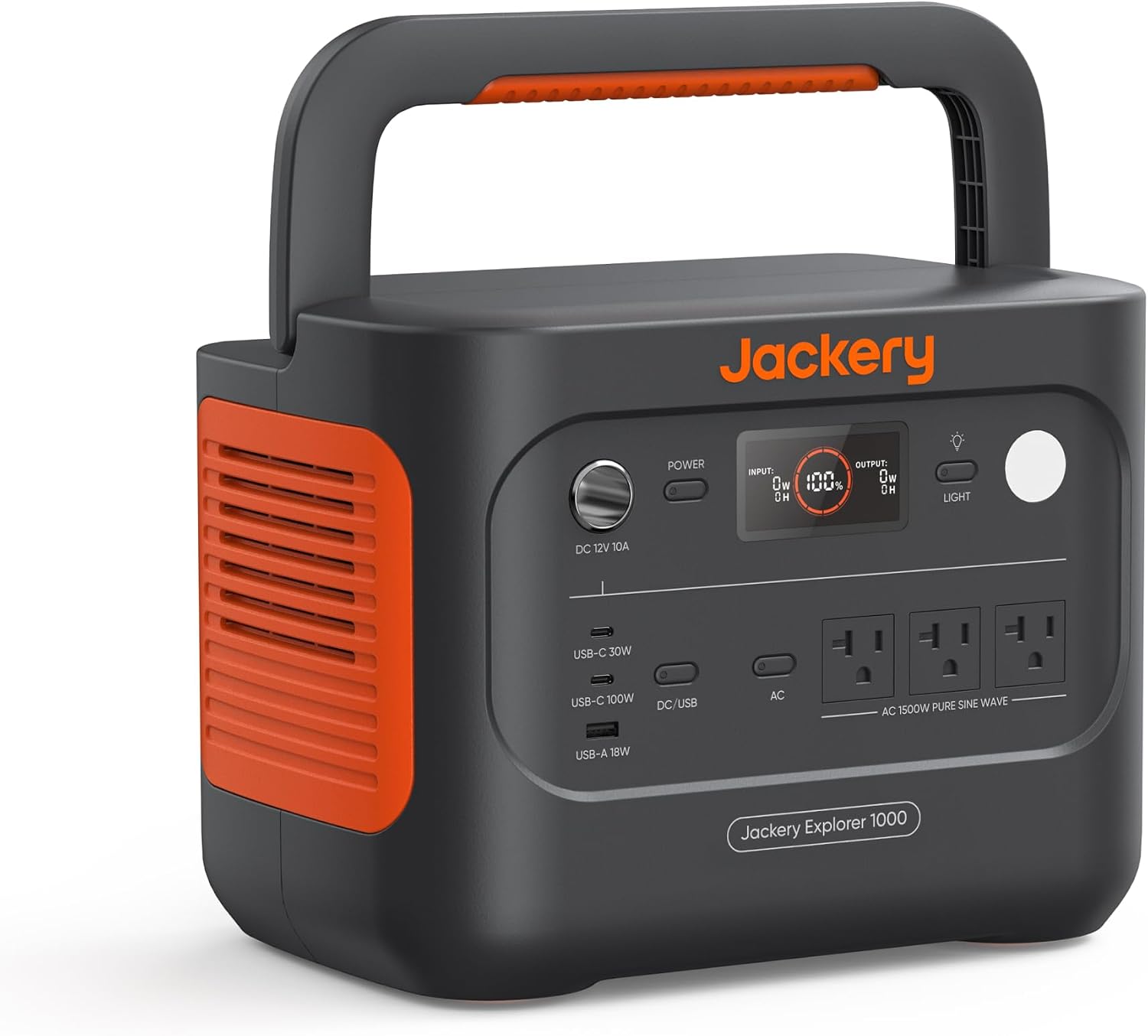
The Jackery Explorer 1000 v2 is a strong fit for buyers who want a well-rounded power station without chasing the fastest possible recharge. Its 1,070Wh capacity, 1,500W continuous output, and class-leading 5-year warranty cover most camping and home-backup scenarios comfortably, backed by Jackery's wide accessory ecosystem. The trade-off is charging speed: an hour to 80% trails the fastest rivals in this capacity class.
Pros
- 1,500W continuous AC output, among the highest in its capacity class
- 5-year cell warranty (3-year standard plus 2-year extended) beats most competitors
- 23.8 lbs, lighter than several similarly sized rivals
- Emergency Super Charge reaches 0-100% in 1.7 hours via wall power
- Jackery app adds remote monitoring and emergency-charge toggling
Cons
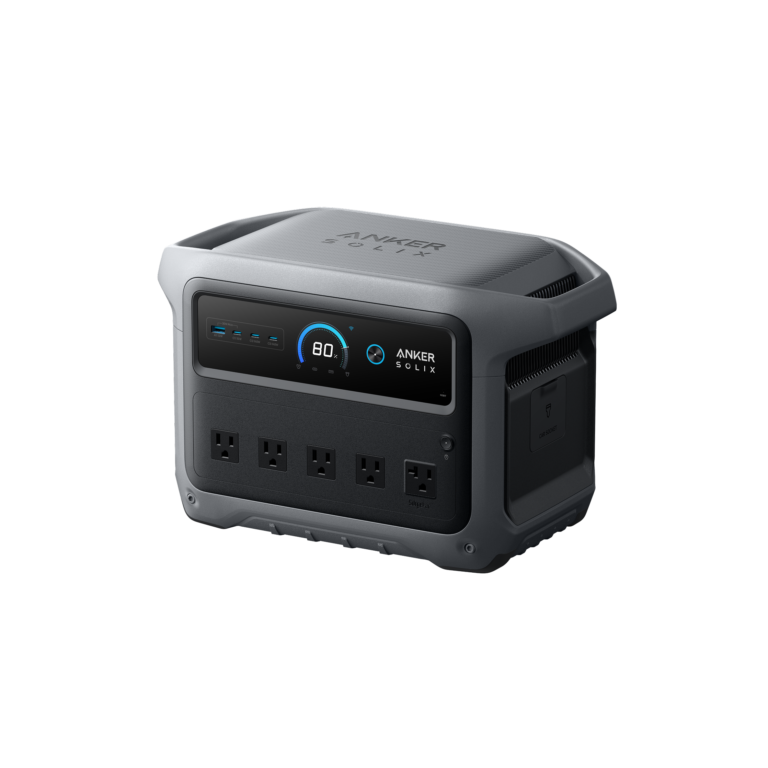
- 80% charge in 1 hour trails the Anker SOLIX C1000 Gen 2's 49-minute full charge
- 800W solar input requires Jackery's proprietary panels, not universal MC4
- $799 MSRP is on par with faster-charging rivals
Overview
Jackery built its name on power stations for people who’d rather not think about power stations — plug it in, charge it, forget it’s there until an outage or a camping trip calls for it. The Explorer 1000 v2 keeps that formula intact while pushing the numbers further: 1,070Wh of LiFePO4 capacity and 1,500W of continuous AC output, enough to run a mini fridge, a set of power tools, or a household’s essentials during a blackout.
The bigger change is underneath the hood. Jackery backs the cells with a 5-year warranty — a 3-year standard term plus a 2-year extension — well beyond what most rivals in this capacity class offer, and rates the pack for 4,000 charge cycles before falling to 80% of original capacity, which works out to roughly a decade of regular use.
Key Specifications
| Battery Capacity | 1,070Wh LiFePO4 (4,000 cycles to 80% capacity) |
| AC Output | 1,500W continuous |
| Charge Time | 0–80% in 1 hour (AC), 0–100% in 1.7 hours |
| Solar Input | Up to 800W (Jackery SolarSaga panels) |
| Dimensions | 13.5 x 10.3 x 11 in |
| Weight | 23.8 lbs |
| Ports | Dual 100W USB-C, USB-A, multiple AC outlets |
| Warranty | 3-year standard + 2-year extended (5 years total) |
Jackery Explorer 1000 v2 Charging Speed & Runtime
The Explorer 1000 v2 takes an hour to reach 80% on AC power and 1.7 hours to hit a full charge — solid for the category, though it trails the fastest rivals. Jackery’s Emergency Super Charge mode, toggled through the companion app, prioritizes speed over efficiency when a storm is inbound and there isn’t time to wait for a leisurely top-off.
Once charged, the 1,500W continuous output covers most single-appliance loads without issue — a full-size fridge, a router and a few lamps during an outage, or a blender and coffee maker at a campsite. Jackery doesn’t publish a distinct peak-surge rating the way some competitors do, so buyers running compressor-heavy loads should check appliance startup wattage against the 1,500W ceiling before assuming headroom.
Portability & Build Quality
At 23.8 lbs, the Explorer 1000 v2 is noticeably easier to lift and carry than several 1,000Wh-class rivals, and its 13.5 x 10.3 x 11-inch footprint fits into a car trunk or closet shelf without dominating the space. GP Reviews’ hands-on writeup described the build as solidly assembled, with a top-mounted handle that stays comfortable even with the unit near its rated weight.
The tradeoff for that more compact shape is a slightly smaller AC output ceiling than bulkier competitors — Jackery prioritized size and weight over squeezing out the last few hundred watts of continuous power.
App Control & Emergency Backup
The Jackery app handles the basics well: live battery percentage, input/output wattage, and remote toggling of the Emergency Super Charge function from a phone rather than the unit itself. It’s a more utilitarian app than some competitors’ — there’s no scheduling or time-of-use charging built in — but what’s there works reliably for the core job of monitoring a backup battery.
The 5-year warranty is arguably the bigger differentiator than anything in the app. Most rivals in this price bracket top out around 2–3 years, and a battery meant to sit untouched for months at a time benefits from the extra coverage more than a flashier feature list would.
How Does It Stack Up Against the Competition?
The Explorer 1000 v2 sits alongside a handful of similarly sized 1,000–1,150Wh power stations built for the same camping-and-backup use case.
| Feature | Jackery Explorer 1000 v2 | Anker SOLIX C1000 Gen 2 | EcoFlow DELTA 2 | BLUETTI AC180 |
|---|---|---|---|---|
| Price (USD) | $799 MSRP | $799 MSRP | ~$399 | ~$499 |
| Capacity | 1,070Wh | 1,024Wh | 1,024Wh | 1,152Wh |
| AC Output (Continuous) | 1,500W | 2,000W | 1,800W | 1,800W |
| Warranty | 5 years | Not published | 5-year (extended) | 2 years |
| TTP Review | This review ↑ | Read our review → | — | Read our review → |
Prices change frequently — always verify current pricing before purchasing.
Is the Jackery Explorer 1000 v2 Worth It?
The Explorer 1000 v2 is a strong fit for buyers who want a well-rounded power station without chasing the fastest possible recharge — its lighter build, class-leading 5-year warranty, and dependable 1,500W output cover most camping and home-backup scenarios comfortably. Jackery’s brand reputation and wide accessory ecosystem (solar panels, car chargers) add practical value beyond the spec sheet.
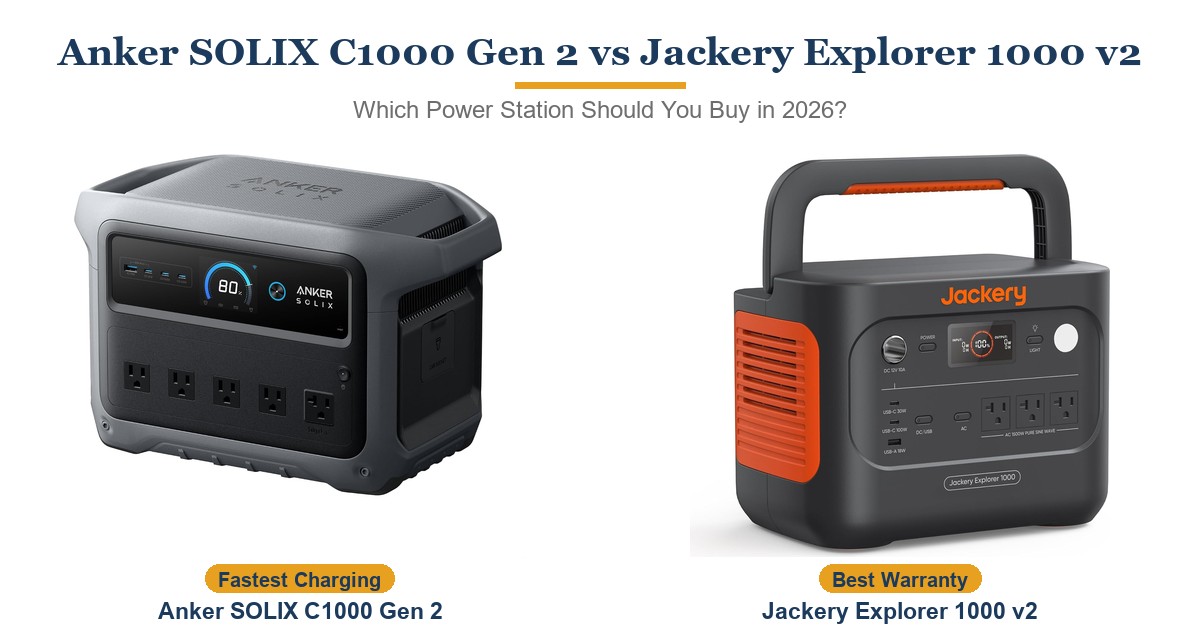
Buyers who prioritize the fastest possible recharge should look at the Anker SOLIX C1000 Gen 2, which reaches a full charge in under an hour versus the Explorer 1000 v2’s 1.7 hours. At the same $799 MSRP, that speed advantage is Anker’s main selling point over Jackery’s longer warranty.
Still comparing power station options? See our How to Choose a Portable Power Station for Camping in 2026 →Still comparing power station options? See our How to Choose a Portable Power Station for Camping in 2026 →
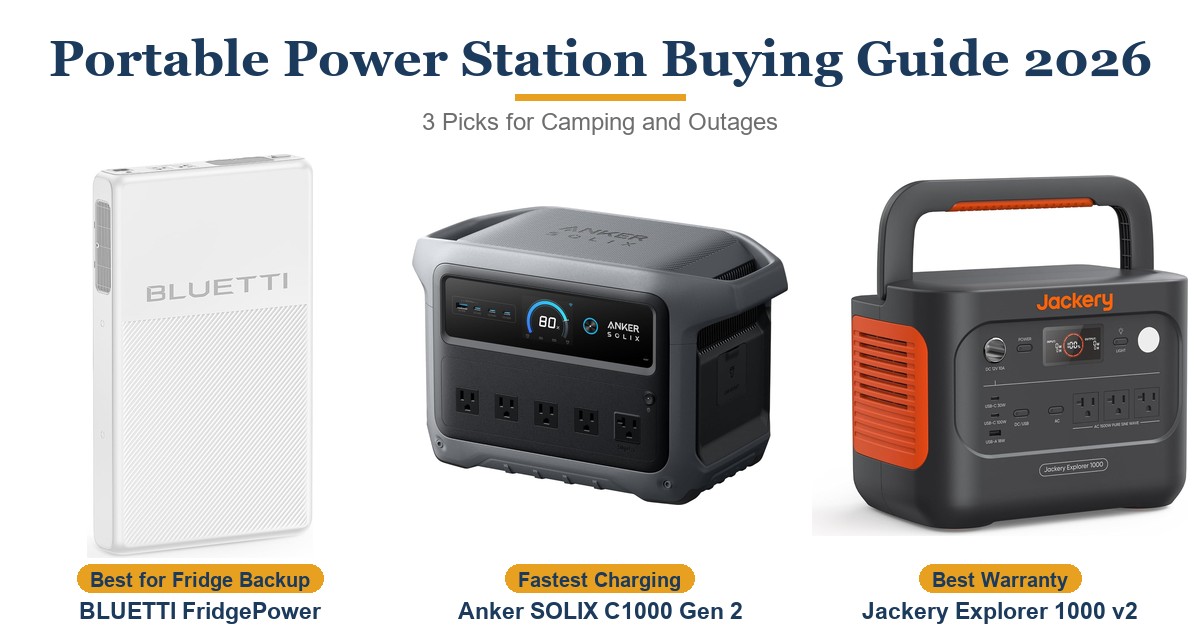
Still comparing portable power station options? See our Anker SOLIX C1000 Gen 2 vs Jackery Explorer 1000 v2 →Still comparing portable power station options? See our Anker SOLIX C1000 Gen 2 vs Jackery Explorer 1000 v2 →
Check the latest price for Jackery Explorer 1000 v2