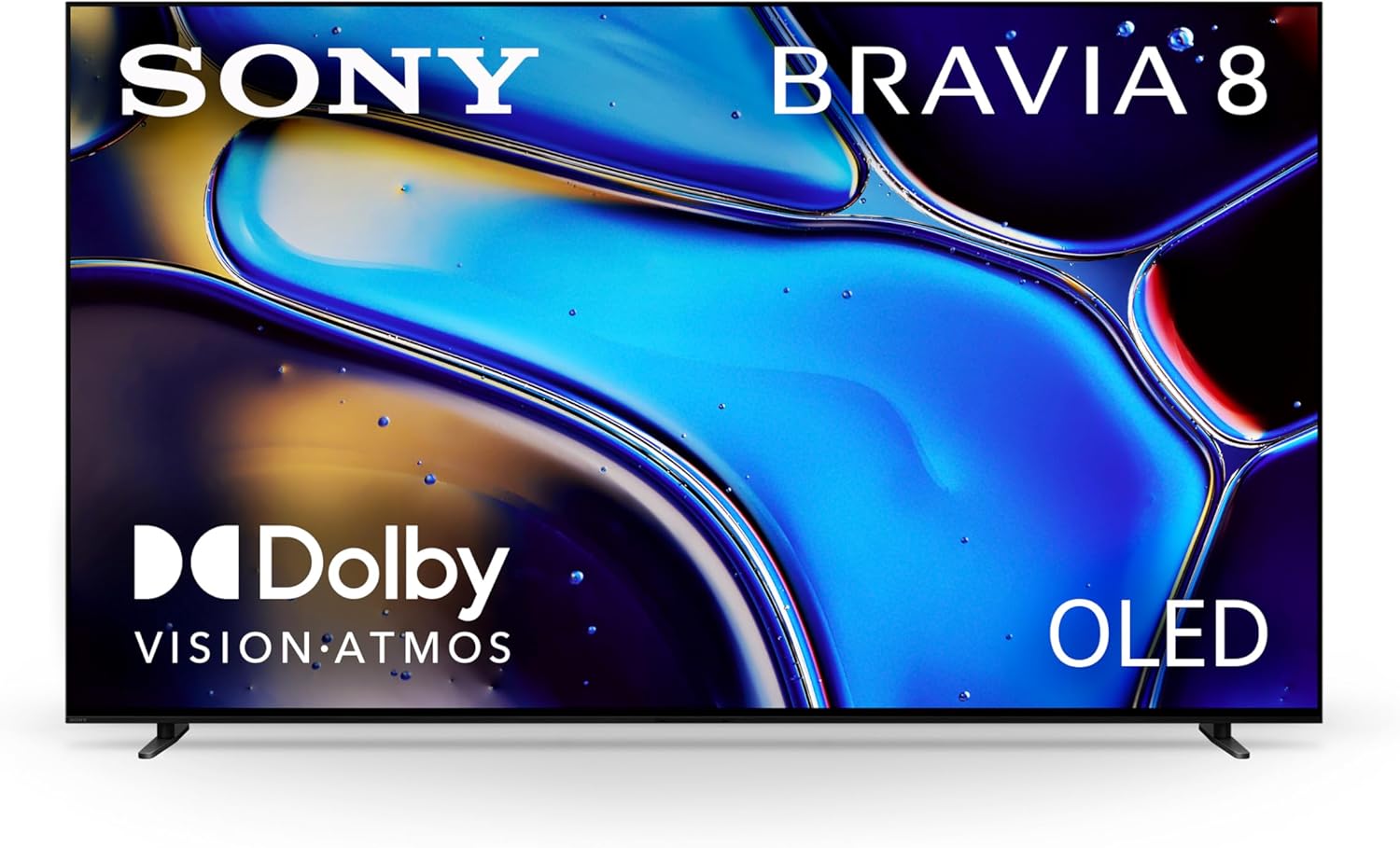
Buy the Bravia 8 if its built-in sound and Sony's natural, film-like picture processing matter enough to pay more than for LG's C6, which costs less as of October 2026 and measured brighter and more colour-accurate in testing, so the Bravia 8 fits a dim room better than a bright one. Most testers rank its screen-as-speaker sound among the better systems built into a TV, and it adds smooth motion, Dolby Vision and a flexible stand that fits a soundbar. Gamers with two consoles and a soundbar should pick the C6 for its four HDMI 2.1 ports.
Pros
- Natural, lifelike picture with true OLED blacks
- Smooth, artefact-free motion handling
- Built-in sound most testers rate above typical TV speakers
- Dolby Vision for films and games
- Flexible stand fits narrow furniture or a soundbar
Cons
- Dimmer than newer rival OLEDs, so best in a dim room
- Only two HDMI 2.1 ports, one shared with eARC
- Tops out at 120Hz, with no HDR10+
- Priced above the LG C6 as of October 2026
As an Amazon Associate I earn from qualifying purchases. Disclosure
Overview
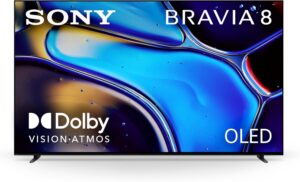
Sony’s Bravia 8 is an OLED for people who care more about how a film looks and sounds than about winning a spec-sheet comparison. It pairs a standard WOLED panel with Sony’s XR Processor and a sound system that turns the screen itself into a speaker, and it comes in 55, 65 and 77 inches. What Hi-Fi? named it its TV Product of the Year in 2024, and its updated review still calls it a five-star set, though the outlet now recommends LG’s C5 as its mid-range OLED pick.
It arrived in 2024 to replace the A80L, and Sony kept it on sale after adding the QD-OLED Bravia 8 II above it in 2025. That leaves it facing newer rivals that, as of October 2026, cost less on Amazon: the 2026 LG C6 and Samsung S90H. Its case rests on Sony’s natural, film-like picture processing and on built-in sound that most testers rate well above typical TV speakers.
Key Specifications
| Price (USD) | Deal $1,598.00 |
| Screen sizes | 55, 65 and 77 inches |
| Panel | WOLED, 3840 x 2160, 120Hz |
| HDR formats | HDR10, HLG, Dolby Vision (no HDR10+) |
| Processor | XR Processor |
| HDMI | 4 inputs; HDMI 3 and 4 are HDMI 2.1 (4K/120Hz, VRR); eARC on HDMI 3 |
| Speakers | Acoustic Surface Audio+, 50W (2 actuators, 2 tweeters, 1 subwoofer); Dolby Atmos, DTS:X |
| Smart platform | Google TV; Chromecast built-in, AirPlay, Apple HomeKit |
| Wireless | Wi-Fi 802.11ax (2.4, 5 and 6 GHz), Bluetooth 5.3 |
| Dimensions (65″, without stand) | 1,442 x 829 x 37 mm (56 7/8 x 32 3/4 x 1 1/2 in) |
| Weight (65″, without stand) | 22.3 kg (49.2 lb) |
| Wall mount | VESA 300 x 300 mm |
Sony Bravia 8 Picture Quality
The Bravia 8’s picture aims for realism over flash. Colours are rich and lifelike, and because each OLED pixel makes its own light, blacks are true black with no blooming around bright objects. What Hi-Fi?, which ran it side by side with the A80L, found warmer, more realistic skin tones and improved light control that gives the image a strong sense of depth. Motion handling is a highlight, smooth and free of artefacts on fast pans, though What Hi-Fi? saw a very slight stutter on rapid movement in Professional mode. The viewing angle is wide enough that people at the ends of a sofa see much the same picture as the person in the middle.
Brightness is where it gives ground, which makes it a better fit for a dim room than for daytime viewing in a sunny one, where a brighter OLED or Mini LED TV is the better choice. In Tom’s Guide’s test it reached 815 nits on a 10% HDR window; the same test put the 2026 LG C6 at 1,355 nits and Sony’s own Bravia 8 II at 1,584. Sony’s Professional mode, its closest equivalent to Filmmaker Mode, is especially dim with SDR content: two testers measured about 99 nits, so raise the brightness in that mode or switch to Cinema mode for everyday TV. RTINGS finds it bright enough in SDR to beat glare from indirect light but rates direct reflections as distracting, while TechRadar noticed reflections under overhead lights without finding them a distraction.
What Hi-Fi? rates its shadow detail excellent overall but saw some black crush, a loss of detail in the darkest areas, in particularly dark scenes; Trusted Reviews saw it in Cinema and Standard modes in a bright room, though blacks in Professional mode looked spot on. Out of the box it also measured less colour-accurate than LG’s C-series in two tests. Tom’s Guide’s Delta-E reading for it was more than double the LG C6’s 1.53 in the same test (lower is better). Its colour range is wide, though: two tests found it covers about 99% of the UHDA-P3 gamut used for HDR.
Built-In Sound
Acoustic Surface Audio+ uses two actuators behind the panel to vibrate the screen, backed by two tweeters and a subwoofer, for 50W in all. The result testers noticed most is placement: voices and effects seem to come from where they happen on screen, and dialogue stays clear. Voice Zoom 3 raises or lowers voices, and TechRadar found it made speech easier to hear without sounding separate from the rest of the soundtrack.
Most testers rank it among the better sound systems built into a TV, and Tom’s Guide goes furthest, calling the results industry-leading and saying no other current built-in TV audio matches its clarity. Trusted Reviews disagrees: it heard the Bravia 8 as thinner than the A80L and short on punch. Bass is the weak point for most of them, though Tom’s Guide found it handled thumping bass well, and a soundbar still adds the low-end rumble action films need; with a compatible Sony soundbar, Acoustic Center Sync uses the TV as the centre channel. Built-in sound is a real point in its favour over the LG C6, whose speakers Tom’s Guide says leave something to be desired.
Gaming and Connections
For one console, the Bravia 8 covers the essentials: 4K at 120Hz, VRR, ALLM and Dolby Vision gaming, plus PS5 features that switch to game mode and set HDR tone mapping automatically when a PlayStation 5 is connected. Input lag came in at 12.6 to 12.8 ms across three tests, and reviewers read that differently: Trusted Reviews puts it on the same level as LG’s C4, while Tom’s Guide calls it high for a TV in this class, noting that Samsung and LG rivals routinely come in under 10 ms. In its tests the LG C6 drops to 9.1 ms in Boost mode.
Ports are the catch. A soundbar on eARC occupies HDMI 3, one of just two HDMI 2.1 inputs (3 and 4), leaving a single full-speed input for games. Add a PS5 and an Xbox Series X to that soundbar and one console has to make do with a slower port unless you swap cables. LG’s C6 and Samsung’s S90H give all four inputs HDMI 2.1 bandwidth and run up to 165Hz for PC gaming; the Bravia 8 stops at 120Hz and lacks built-in Nvidia G-Sync and AMD FreeSync support.
Design, Stand and Google TV
The 65-inch model is 37 mm (1.5 in) deep with a flat back that sits flush on a wall, and it takes a standard 300 x 300 mm VESA mount. On furniture, the feet go near the centre (584 mm, or 23 in, apart) for a narrow stand or out at the corners (1,244 mm, or 49 in, apart), and either way they can sit low or raised to make room for a soundbar. What Hi-Fi? would have liked a swivel, which would make the side-facing HDMI inputs easier to reach.
It runs Google TV with the Play Store, and has Chromecast, AirPlay, Apple HomeKit and a built-in microphone for voice search. Reviewers split on its speed: Trusted Reviews found the interface responsive and slick, while TechRadar found it slow and clunky next to LG’s webOS. US buyers also get an ATSC 3.0 tuner for 4K over-the-air broadcasts.
Sony has since added a Bravia 8A version with a more basic remote and fewer Sony Pictures Core movie credits; What Hi-Fi? says its performance is identical.
How Does It Stack Up Against the Competition?
Three 65-inch OLEDs a Bravia 8 shopper is likely to weigh: LG’s and Samsung’s 2026 mid-range sets, and Sony’s own step-up QD-OLED.
| Feature | Sony Bravia 8 | LG C6 | Samsung S90H | Sony Bravia 8 II |
|---|---|---|---|---|
| Price (USD) | Deal $1,598.00 (65") | $1,399.99 (65") | $1,397.99 (65") | Deal $2,198.00 (65") until Nov 22 |
| Panel | WOLED | WOLED | WOLED | QD-OLED |
| HDR brightness, 10% window (Tom’s Guide test) | 815 nits | 1,355 nits | 1,497 nits (55-inch tested) | 1,584 nits |
| HDMI 2.1 ports | 2 of 4 | 4 of 4 | 4 of 4 | 2 of 4 |
| Top refresh rate | 120Hz | 165Hz | 165Hz | 120Hz |
| Input lag (Tom’s Guide test) | 12.6 ms | 12.9 ms (9.1 ms in Boost) | 9.3 ms (55-inch tested) | 16.3 ms |
| Dolby Vision | Yes | Yes | No | Yes |
| Speaker system | Screen as speaker (Acoustic Surface Audio+) | 2.2-channel | 2.1-channel | Screen as speaker (Acoustic Surface Audio+) |
| Smart platform | Google TV | webOS 26 | Tizen (One UI) | Google TV |
| TTP Review | This review ↑ | Read our review → | — | — |
| Amazon | View on Amazon | View on Amazon | View on Amazon | View on Amazon |
Prices change frequently — always verify current pricing before purchasing.
Sony Bravia 8: Worth It for Its Sound and Natural Picture
Its strongest case is for viewers who put sound and natural picture processing first: most testers rate its speakers among the better ones built into a TV, its motion handling is smooth, and it supports Dolby Vision, which the Samsung S90H doesn’t. Watch the price, though. RTINGS called LG’s older C4 “the better choice for almost everyone”, and What Hi-Fi? picked the Bravia 8 over the C5 mainly because the C5 was new and still at full price when it compared them. That edge has since gone: as of October 2026 the 65-inch LG C6 is $1,499.99 on Amazon against $1,998.00 for the Bravia 8.
For a sunny room, the S90H’s anti-glare screen and higher brightness are the better fit. Gamers with two consoles or a gaming PC should choose the LG C6 for its four HDMI 2.1 ports and 165Hz support. If you want Sony’s processing with more punch, the QD-OLED Bravia 8 II is more colourful, though its input lag is higher and, as of October 2026, it costs more.
Sources
- Sony — K-65XR80 Specifications
- Sony Bravia 8 (65-inch) — Amazon Product Listing
- Tom’s Guide — Sony Bravia 8 OLED TV review
- What Hi-Fi? — Sony Bravia 8 review
- TechRadar — Sony Bravia 8 review: high-end performance without the price
- Trusted Reviews — Sony Bravia 8 OLED Review
- RTINGS — Sony BRAVIA 8 OLED TV Review
- What Hi-Fi? — LG C5 vs Sony Bravia 8: which OLED TV should you buy?
- What Hi-Fi? — Sony Bravia 8 II vs Bravia 8: which OLED TV should you buy?
- What Hi-Fi? — Sony Bravia 8 II review
- TechRadar — Sony Bravia 8 II review
- Tom’s Guide — LG C6 OLED review
- Tom’s Guide — Samsung S90H OLED TV review
- T3 — Samsung S90H review
Reader Poll
Would two full-speed HDMI 2.1 ports be enough for your setup?
Help Our Editors Know What Matters to You
Explore on Amazon →