How Fitness Trackers Actually Measure Your Heart Rate
Every running watch and recovery ring on this site quotes a heart-rate number without ever explaining where it comes from. Here’s the actual sensor and math behind it — and exactly where it quietly gets things wrong.
Sources
Titoma — PPG Sensor Design Guide, Samsung Display — Photoplethysmography, PMC — Motion Artifact Reduction in Wearable PPG, and a PLOS One skin-tone accuracy study.
What You’ll Understand
- Why wearables use light, not electricity, to find your pulse
- Why every sensor glows green instead of red or white
- Why hard workouts confuse the sensor more than rest does
- Why a ring often reads more accurately than a watch
- Where the accuracy claims on the box quietly break down
Open any running-watch or fitness-ring comparison and you’ll find a heart-rate number treated as a plain fact — accurate to the beat, updated every few seconds, no different in principle from the finger clip at a doctor’s office. It isn’t. Nothing on your wrist or finger touches your bloodstream or reads an electrical signal at all. It shines light into your skin and measures what bounces back. That one distinction explains why two devices on the same wrist can disagree by 15 beats per minute mid-interval, and why the accuracy printed on the box holds up differently depending on your skin tone, your finger temperature, and how hard you’re actually working.
Light, Not Electricity: How a PPG Sensor Actually Works
The technology inside almost every wrist and finger wearable is called photoplethysmography, or PPG. A PPG sensor pairs an LED with a photodiode — a light-sensitive receiver — pressed against your skin. The LED fires continuously, and the photodiode measures how much of that light gets reflected back. Blood is not a static volume sitting under your skin; every time your heart contracts, a fresh pulse of blood pushes into the capillaries near the surface, and that extra blood volume absorbs more light than the tissue around it does. When the heart relaxes between beats, blood volume in those capillaries drops slightly, and more light reflects back to the sensor. The result is a light signal that rises and falls in a steady rhythm, and that rhythm is the pulse. The device doesn’t measure your heart directly — it measures the shadow your heartbeat casts in reflected light, then counts how often that shadow repeats.
A green LED shines into the skin; a photodiode measures how much bounces back. Blood volume rises and falls with every heartbeat, so the reflected light dims and brightens in the same rhythm — that repeating rhythm is the “heart rate” number on the screen.
Why Every Wearable’s Sensor Glows Green
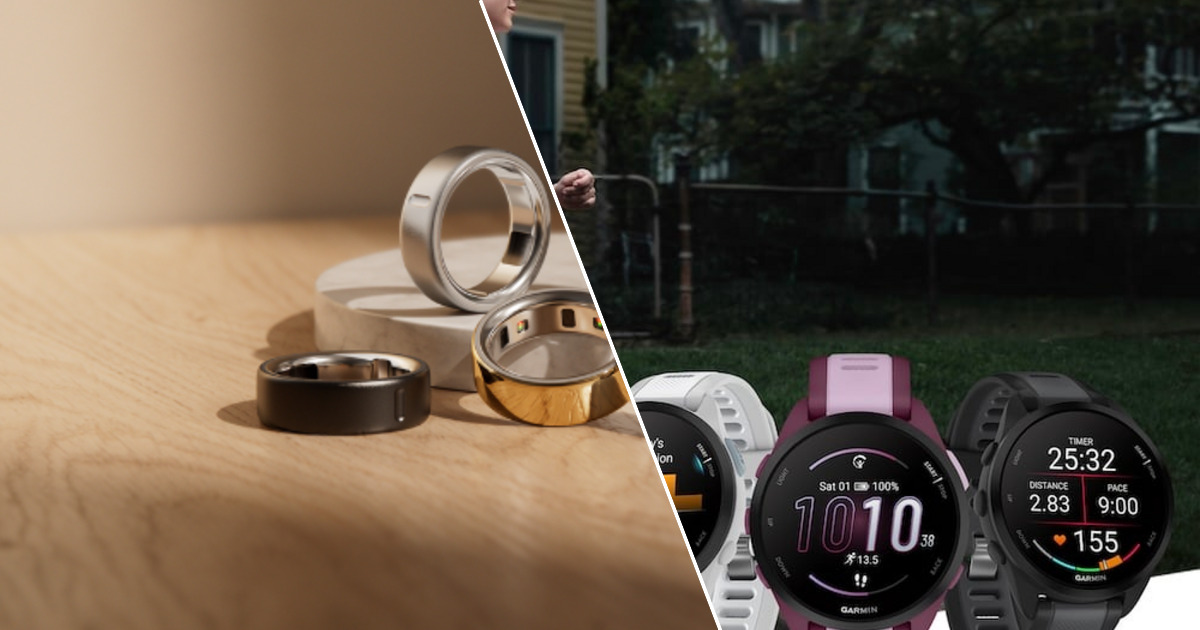
Look at the underside of almost any smartwatch or fitness ring and you’ll see a green glow, sometimes mixed with red or infrared. That color isn’t cosmetic. Hemoglobin, the molecule in blood that carries oxygen, absorbs green light far more strongly than infrared light — up to roughly 20 times more, according to Samsung Display’s engineering explainer on the technology. That matters because the wrist has comparatively little blood flow to work with compared to a clinical sensor site like a fingertip in a hospital pulse oximeter. Green light produces a stronger, cleaner absorption signal from that thinner blood supply, which is why it became the default choice even though it’s more easily blocked by tattoos, hair, and pressure marks than infrared is. Higher-end sensors, like the 18-path array Oura uses in its ring, fire red, green, and infrared LEDs across multiple points simultaneously and blend the results — more wavelengths and more sampling points give the algorithm several independent readings to cross-check against each other, which is a large part of why that sensor produces steadier data than a single-LED optical sensor like Garmin’s Elevate array.
The Real Problem Isn’t the Sensor — It’s You Moving
A PPG sensor works cleanly at rest because the only thing changing the light signal is your pulse. The moment you start running, that stops being true. Your arm swings, the device shifts against your skin, and each of those movements changes how much light reaches the photodiode — often by far more than your actual pulse does. Unlike an electrical sensor, PPG has no built-in way to tell “the signal changed because of a heartbeat” from “the signal changed because the watch case just bumped your wrist.” Manufacturers compensate with an accelerometer built into the same chip package, feeding a technique called adaptive noise cancellation: the algorithm treats the accelerometer’s motion reading as a reference signal and mathematically subtracts the parts of the optical signal that correlate with it, isolating what’s left as the true pulse. Published research on multi-channel PPG motion correction confirms this works well for rhythmic, predictable motion like running, but degrades on erratic movement. A separate study on wearable accuracy across exercise types measured this directly: wrist PPG was nearly perfect during running (a bias of just 0.1 beats per minute against a reference monitor), but badminton and soccer — sports with sudden, non-repeating arm and wrist motion — produced errors averaging more than 16 beats per minute. The sensor hasn’t gotten worse; the assumption its algorithm depends on has simply broken down.
Why a Ring Often Reads More Accurately Than a Watch
Moving the same PPG technology from a wrist to a finger changes its accuracy for reasons that have nothing to do with the electronics. The digital arteries in your fingers run closer to the surface than the vessels in your wrist, the capillary bed is denser, and the skin is thinner with more consistent thickness across the finger — all of which produce a stronger, cleaner optical signal before any noise-cancellation algorithm even gets involved. Oura, whose ring is the recurring comparison point in wrist-vs-ring wearable reviews, states in its own accuracy documentation that its finger-based pulse signal runs up to roughly 100 times stronger than a typical wrist sensor picks up. That gap is the real, physical reason a specification like “18-path PPG” reads as more than marketing on a spec sheet — more measurement points and a fundamentally stronger starting signal genuinely produce steadier data, particularly for sleep and resting heart-rate tracking, where the wrist’s weaker signal has less margin for error. The trade-off runs the other way for temperature: cold fingers vasoconstrict, meaning blood vessels narrow and reduce flow to preserve core heat, which weakens the very signal the ring depends on in a way an algorithm can’t fully correct for. A wrist, sitting closer to the body’s core, is less prone to that specific failure.
| How it senses your pulse | Wrist watch (PPG) | Finger ring (PPG) | Chest strap (ECG) |
|---|---|---|---|
| Signal source | Light through skin, moderate strength | Light through skin, far stronger signal | Electrical impulse straight from the heart muscle |
| Accuracy during hard intervals | Degrades — motion swamps the optical signal | Better than wrist, still not lab-grade | Largely immune to motion noise |
| Accuracy across skin tones | Documented gap — darker skin sees roughly 4x higher error at high intensity | Same optical limitation, less independently studied | No melanin-related gap — not light-based |
| What you wear | Watch on the wrist | Ring on the finger | Strap around the chest |
| Typical extra cost | Included in the device | Included in the device | $50–$100 additional hardware |
The Accuracy Gap the Spec Sheet Doesn’t Mention
The single most important limitation of wrist-based PPG has nothing to do with the brand or the price tier, and it rarely appears in marketing copy. A peer-reviewed study published in PLOS One measured wrist-monitor accuracy across skin tones during exercise and found the error grows sharply, and unevenly, as intensity increases. At high intensity — above 60% of heart-rate reserve — the study measured roughly 4 beats per minute of error for lighter skin tones versus roughly 16 beats per minute for darker skin tones, a fourfold gap. The mechanism is the same green-light absorption discussed above: greater melanin concentration absorbs more of the green light the sensor depends on, degrading the very signal the algorithm needs precisely when your heart rate is changing fastest and precisely when accuracy matters most for training safely. An ECG chest strap sidesteps this entirely, because it reads an electrical impulse rather than reflected light, which is why devices like the Polar H10 remain the reference standard researchers compare optical wearables against rather than the other way around. None of this makes a wrist or ring sensor useless — for steady-state activity and resting measurements, modern PPG is genuinely reliable — but it does mean the “accuracy” printed on a product page describes a best case, not a universal one.
What This Means When You’re Buying
None of this changes which wearable is the right purchase for a given person — it just explains why the spec sheets read the way they do. A device advertising a multi-wavelength, multi-path sensor genuinely does have a physical reason to be steadier at rest; a device you plan to wear through interval training or contact sports will lose accuracy for reasons no firmware update can fully fix; and if your training genuinely depends on precise heart-rate zones during hard efforts, pairing any optical wearable with an ECG chest strap remains the most reliable fix available today. The two guides below cover exactly this trade-off across real current devices.
As an Amazon Associate I earn from qualifying purchases. Disclosure
Not the focus of this piece, but if accurate heart-rate zones during hard training matter to you: search heart rate chest strap monitor on Amazon →search heart rate chest strap monitor on Amazon.ca →
Sources
- Titoma — How Does a PPG Sensor Work? Design Guide for Wearables
- Samsung Display — Monitoring Heart Rate with LED? Photoplethysmography (PPG)
- PMC — Motion Artifact Reduction in Wearable Photoplethysmography Based on Multi-Channel Sensors with Multiple Wavelengths
- PMC — Impact of Anatomical Placement on the Accuracy of Wearable Heart Rate Monitors During Rest and Various Exercise Intensities
- PLOS One — Validity of Heart Rate Measurements in Wrist-Based Monitors Across Skin Tones During Exercise
- Oura — The Accuracy Advantages of Finger-Worn Wearable Devices