How to Jump-Start a Car Safely With a Portable Jump Starter
A charged jump pack gets a dead car running without a second vehicle, as long as the battery is safe to jump and the clamps go on in the right order. Here is the sequence, and the checks that keep it safe.

How We Researched
Steps drawn from NOCO’s GB40 user guide and support page, cross-checked against jump-start guides from Battery Tender, Bumper, Car and Driver and The Drive. No manufacturer paid for placement.
* As an Amazon Associate I earn from qualifying purchases. Disclosure
What You’ll Learn
- How to match a pack to your engine and battery
- Which battery problems mean you shouldn’t jump at all
- The clamp order, and where the black clamp can go
- How long to wait between start attempts
- How to disconnect, and what a second dead battery tells you
- How to recharge and store the pack so it’s ready next time
2 jump starters referenced in this guide
Wondering how to jump-start a car with a portable jump starter without sparks, blown fuses or a pack that refuses to cooperate? The whole job takes a few minutes, and most of the risk sits in three places: a battery that shouldn’t be jumped, clamps on the wrong terminals, and cranking for too long. The order below suits most lithium jump packs, but your pack’s manual and your car’s owner’s manual have the final say.
Step 1: Check the Pack’s Charge and Engine Rating
A jump pack is rated by engine size, so look up yours before you rely on it. NOCO’s GB40 support page, for example, rates the compact GB40 for gas engines up to 6.0 liters and diesels up to 3.0 liters, while its larger GB70 covers gas engines up to 8.0 liters. A pack sized for a four-cylinder sedan may not turn over a big V8 or a diesel truck.
Check the charge lights too, since a flat pack can’t do the job. And confirm the battery type: NOCO says its Boost packs work only on 12-volt lead-acid batteries (wet, gel, maintenance-free, EFB and AGM), which includes a hybrid’s starting battery when that battery is 12V lead-acid. On a 6-volt system or a lithium starting battery, NOCO warns, a jump “could become extremely dangerous.”
Step 2: Inspect the Battery and Switch Everything Off
Look at the dead battery before you clamp anything to it. If it is swollen, physically damaged or leaking, if acid has built up around the terminals, or if you smell rotten eggs, stop: a damaged battery can catch fire or even explode, and replacing it beats jumping it. In cold weather there is one more check. A battery whose acid has weakened can freeze, and McLaren technician Kevin Hines, in Car and Driver’s jump-start guide, is blunt about it: “If you suspect at all the dead battery is frozen, do not try to jump start it.”
If the battery looks sound, put the car in Park, turn the ignition off, and switch off the headlights, radio and air conditioning so nothing is drawing power when the pack connects.
Step 3: Connect Red to Positive, Then Black to Ground
With the pack still switched off:
- Clip the red (+) clamp to the dead battery’s positive terminal, marked POS, P or +.
- Clip the black (−) clamp to clean, unpainted metal on the engine block or chassis, or to the negative terminal (NEG, N or −) if your pack’s manual allows it.
- Keep both clamps away from the fuel lines, the carburetor and thin sheet-metal parts.
Sources split on where the black clamp belongs. NOCO’s manual allows either the negative terminal or the chassis, while Battery Tender and Bumper both say to use a metal ground rather than the negative post, to keep any spark away from the battery, which can give off hydrogen gas. If your pack allows both, the ground point is the safer habit. Bumper also notes that some European carmakers, BMW and Mercedes among them, recommend their own jump-start procedures, so check your owner’s manual first.
Step 4: Power On the Pack and Start the Engine
Switch the pack on and read its lights before you turn the key. On the GB40, a white Boost light means the pack sees the battery and is ready; a solid red error light means the clamps are reversed, and it won’t deliver power until you swap them. That reverse-polarity protection matters: with no protection, positive-to-negative connections can short the circuit, blow fuses and damage electronics.
Then start the car, in short attempts rather than one long crank. The two makers’ instructions differ in the details. Battery Tender says to crank in bursts of 3 to 5 seconds and wait 30 seconds before trying again. NOCO’s GB40 manual says some vehicles need the pack connected for up to 30 seconds before they’ll start, to wait 20 to 30 seconds between tries, and to stop after five attempts in 15 minutes and let the pack rest for 15 minutes. General guides vary more: The Drive suggests waiting a minute or two after connecting and a few minutes between tries, so if your pack’s manual gives its own timing, follow that.
If the pack shows no Boost light on a correctly connected battery, the battery may be below the 2 volts the GB40 can detect. Its Manual Override forces power on for that case, but it switches off the spark-proof and reverse-polarity protection, and NOCO says to use it with extreme care, or to seek professional help if you’re unsure. If the engine cranks strongly but won’t fire, the fault may lie with fuel, the starter or ignition rather than the battery.
Step 5: Disconnect in Reverse Order and Keep It Running
Once the engine is running, turn the pack off and remove the clamps in the reverse of the order they went on: black first, then red. Keep the engine running for at least 20 to 30 minutes, ideally on a drive, so the alternator can put some charge back into the battery. The pack itself won’t do that part; NOCO is clear that its Boost packs jump-start a battery but are not battery chargers.
What happens next tells you what went wrong. If the engine dies as soon as the pack comes off, Hines points to the charging system, such as a failing alternator or a damaged accessory belt or pulley. If the car starts but the battery is flat again within days, the battery may be near the end of its life or something is drawing power while the car is parked; a battery test at an auto parts store tells you which.
Step 6: Recharge the Pack and Store It Out of the Sun
Recharge the pack after every jump, so it’s ready next time rather than half empty. Then store it within its limits. NOCO says its Boost packs shouldn’t be stored below -4°F (-20°C) or above 122°F (50°C), and should be recharged only between 32°F and 104°F (0°C to 40°C). It also warns that the air inside a car in the sun can reach up to 122°F (50°C) within 10 minutes, so keep the pack out of direct sunlight rather than on the dash or seat.
Between uses, NOCO says a Boost pack holds 70% of its rated capacity for up to a year, and recommends charging it at least every four to six months.
The Right Gear Makes It Easier
A good pack makes every step above simpler, mostly through its clamps and its safety electronics.
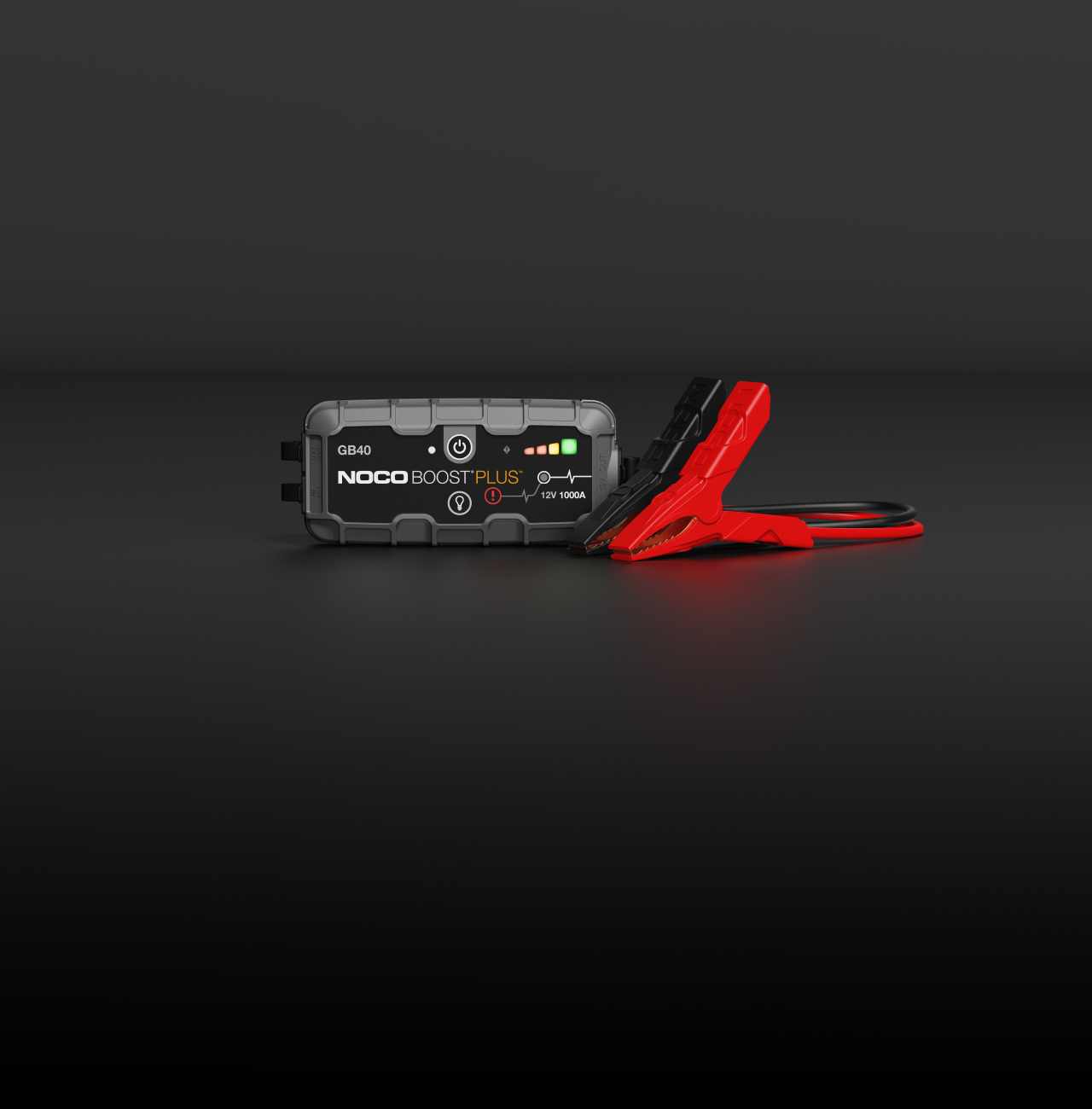
NOCO Boost Plus GB40NOCO Boost Plus GB40 — a glovebox-size pack rated for gas engines up to 6.0 liters, with spark-proof and reverse-polarity protection, and clamps TechGearLab called “the easiest, most secure clamps we tested.”
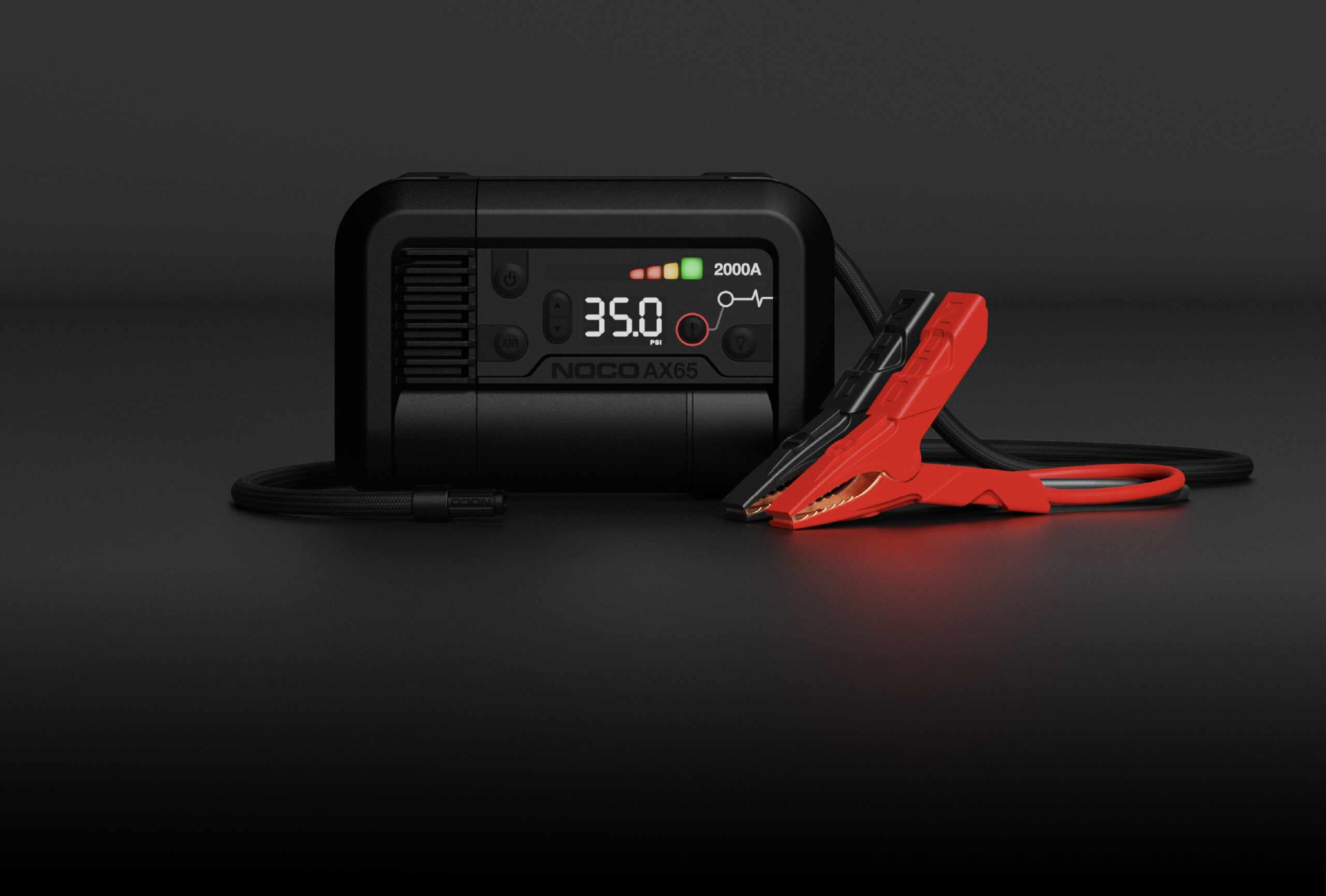
NOCO Boost Air AX65NOCO Boost Air AX65 — for bigger engines (rated up to 8.0-liter gas and 6.0-liter diesel), with a built-in tire pump that shuts off at the pressure you set.
Building a roadside kit? See our Best Car Accessories for Road Trips guide →See our Best Car Accessories for Road Trips guide →
Sources
- NOCO – GB40 User Guide (PDF)
- NOCO – GB40 Support
- NOCO – 1000A Lithium Jump Starter GB40
- NOCO – Boost Air AX65 Jump Starter and Air Compressor
- Battery Tender – How to Jump Start a Car With a Battery Pack
- Bumper – How to Jump Start a Car: Step-by-Step with Jumper Cables or a Jump Pack
- Car and Driver – How to Properly Jump Start a Car
- The Drive – How Do You Start a Dead Car Without Another Car?
- TechGearLab – NOCO Boost Plus GB40 Review