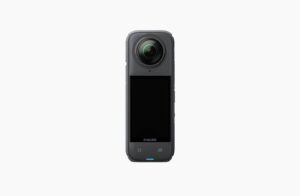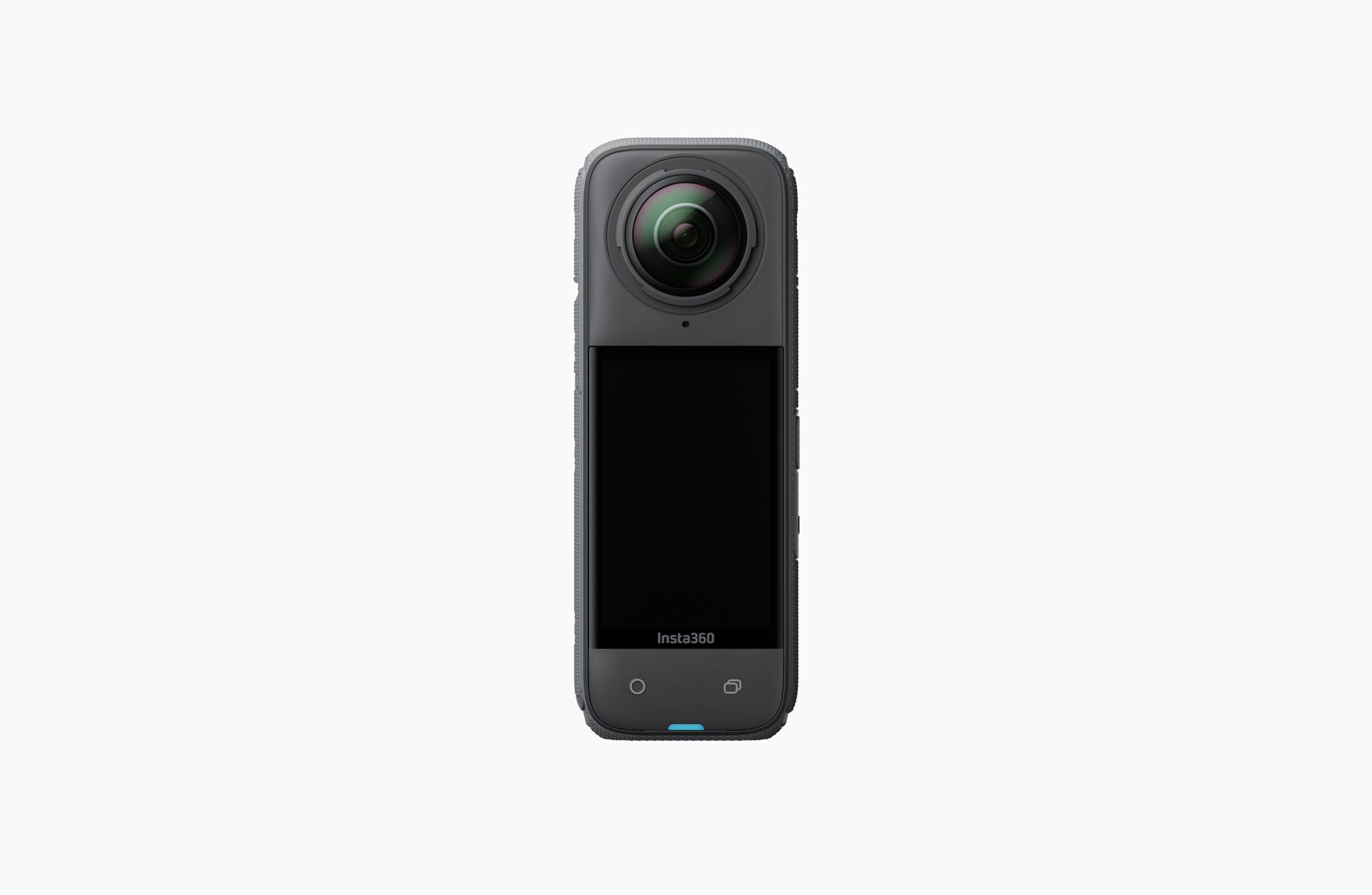
The Insta360 X4 pairs genuine 8K 360° video and 72MP stills with FlowState stabilization and Insta360's mature editing app, all at nearly half the price of the newer X5. Its 135-minute battery and 10-meter waterproofing are solid for day-to-day shooting, and swappable lenses keep repair costs low. The trade-off is sensor size — low-light footage falls noticeably behind the X5's larger sensors, and it won't match the newer camera's 185-minute battery life on long shoots.
Pros
- 8K/30fps 360° video and 72MP stills for nearly half the X5's price
- 135-minute rated battery outlasts the GoPro MAX2's real-world runtime several times over
- 10-meter native waterproofing plus swappable, scratch-resistant lenses
- Same mature Insta360 app, FlowState stabilization, and Horizon Lock as the X5
- Solid build quality that holds up well past its original release cycle
Cons
- Smaller sensors than the X5 mean a real step down in low-light footage
- 135-minute battery trails the X5's 185-minute rating for long shoots
- Two generations behind now that the X5 and X6 are the current flagships
As an Amazon Associate I earn from qualifying purchases. Disclosure
Overview
With the Insta360 X6 now the brand’s flagship and the X5 sitting one tier below that, the two-generation-old Insta360 X4 has settled into a new role: the budget 8K 360° camera. Amazon has been discounting the Standard Bundle since the X6’s August 2026 launch, pushing the street price down to around $360 — nearly $200 less than the X5 it was replaced by. It’s sold on Amazon.com and Amazon.ca alongside Insta360’s own store.
That’s not a camera coasting on an outdated spec sheet, either. The X4 still shoots genuine 8K/30fps 360° video and 72MP blended stills — matching the newer X5 on both numbers — with the same FlowState stabilization and invisible-selfie-stick shooting style that made the line popular in the first place. The trade-off for the lower price is sensor size: Insta360 moved to larger 1/1.28-inch sensors for the X5, and the X4’s smaller sensors are the main reason it now sits a tier below.
Key Specifications
| Camera System | Dual-lens 360°, smaller sensors than the X5 |
| Video | 8K/30fps 360° HDR, 5.7K/60fps 360°, 4K/60fps single-lens, 4K/100fps single-lens slow-mo |
| Still Photos | 72MP blended 360° stills |
| Weight | 203 g (7.16 oz) |
| Dimensions | 123.6 x 46.0 x 37.6 mm (4.9 x 1.8 x 1.5 in) |
| Rated Battery Life | 135 minutes at 5.7K/30fps (2,290mAh) |
| Charging | 38 minutes to 80%, 55 minutes to 100% (9V/2A) |
| Waterproofing | 10 m (33 ft) native; 50 m (164 ft) with the optional Dive Case |
| Stabilization | FlowState + 360° Horizon Lock |
| Lenses | User-replaceable, scratch-resistant coating |
| Price (USD) | $424.99 |
Insta360 X4 360° Video & Photo Quality
On paper, the X4 keeps pace with its pricier successor: both shoot 8K/30fps 360° video and produce 72MP blended stills. TechRadar’s review called the X4 the most capable handheld 360° camera it had tested at the time, pointing to its 8K resolution, effective 4K single-lens mode, and solid build quality as reasons it beat out rival action cameras that year. Tom’s Guide went further, awarding it an Editor’s Choice and noting that its single-lens 4K/60fps mode lets it compete directly with dedicated action cameras like the GoPro line, not just other 360° models.
The gap shows up in dim conditions. TechRadar listed low-light image quality as one of the X4’s few real weaknesses, and Insta360 itself addressed exactly that limitation with the X5’s larger 1/1.28-inch sensors a year later. Daylight and well-lit indoor footage from the X4 still holds up well against current rivals; it’s after dark or in dim venues where the smaller sensors start to show noise the X5 doesn’t.
Battery Life & Charging
Tom’s Guide specifically praised the X4’s battery and thermal performance among its pros, and the numbers back that up: a 2,290mAh cell rated for 135 minutes of continuous 5.7K/30fps shooting is well ahead of GoPro’s MAX2, which real-world testing puts closer to 30–40 minutes per charge in the same resolution class. Fast charging helps too — 38 minutes gets the X4 back to 80%, useful for topping up between shooting sessions rather than waiting out a full recharge.
The X5 still out-lasts it, rated for 185 minutes on the same test, a genuine advantage for creators doing all-day shoots without spare batteries. For shorter outings — a hike, a day at the beach, an afternoon of content clips — the X4’s 135-minute rating is enough runway that battery anxiety isn’t the reason to spend the extra $190 on the newer model.
App, Stabilization & Editing Workflow
The X4 runs on the same Insta360 app ecosystem as every camera in the lineup, including the X5 and X6, which means the reframing, editing, and straight-to-social export tools reviewers consistently rank as the most mature in the 360° camera category are unchanged here. FlowState stabilization and 360° Horizon Lock handle the processing that keeps handheld or mounted footage level, even when the camera itself was tumbling mid-shot.
Because every 360° camera requires reframing raw dual-lens footage into a shareable 2D clip before it’s watchable on a phone or social feed, the quality of that app step matters as much as the sensor hardware. Buying into the X4 today means buying into the same software Insta360 keeps updating for its newer flagships — a rare case where an older camera doesn’t fall behind on the software side even as newer hardware supersedes it.
Durability, Waterproofing & Replaceable Lenses
The X4 is natively waterproof to 10 meters (33 feet), with an optional Dive Case extending that to 50 meters (164 feet) for underwater use — a rating that covers most everyday scenarios (pools, kayaking, rain) without any extra housing. Insta360 carried its user-replaceable lens design over from earlier models, so a scratched or cracked lens means swapping a low-cost module rather than replacing the whole $360 camera.
Build quality was another point TechRadar called out favorably, and that solidity is one of the reasons the X4 has stayed a reasonable buy well past its original release — it wasn’t designed as disposable tech meant to be replaced every product cycle, even though Insta360’s own newer models have since done exactly that on the spec sheet.
How Does It Stack Up Against the Competition?
The X4 trades the X5’s larger sensors and longer battery life for a nearly $200 lower price — here’s how the numbers compare against the current field.
| Feature | Insta360 X4 | Insta360 X5 | GoPro MAX2 | Ricoh Theta X |
|---|---|---|---|---|
| Price (USD) | $424.99 | $549.99 | $299.00 | $496.95 (last Amazon price, Oct 4, 2026) |
| Max Video | 8K/30fps 360° | 8K/30fps 360° | True 8K (stitched) | 5.7K/30fps |
| Still Resolution | 72MP | 72MP | ~29MP | 60.5MP |
| Battery Life | 135 min rated | 185 min rated | ~30-40 min real-world | ~30 min (swappable) |
| Waterproofing | 10 m native | 15 m native | 5 m native | Not rated for submersion |
| TTP Review | This review ↑ | Read our review → | Read our review → | Read our review → |
| Amazon | View on Amazon | View on Amazon | View on Amazon | View on Amazon |
Prices change frequently — always verify current pricing before purchasing.
Is the Insta360 X4 Worth It?
For anyone who wants genuine 8K 360° video and 72MP stills without paying flagship pricing, the Insta360 X4 is a legitimately strong buy at its current $360 street price — it matches the X5 on resolution, runs the same mature editing app, and comes with FlowState stabilization and swappable, scratch-resistant lenses.
The trade-off is sensor size: TechRadar flagged low-light image quality as a real weakness, and Insta360’s own X5 fixed that gap with larger sensors the following year. Creators who mostly shoot after dark, indoors, or in dim venues should budget for the X5 instead; anyone shooting mostly in daylight will find the X4 gives up very little for a nearly $200 lower price.