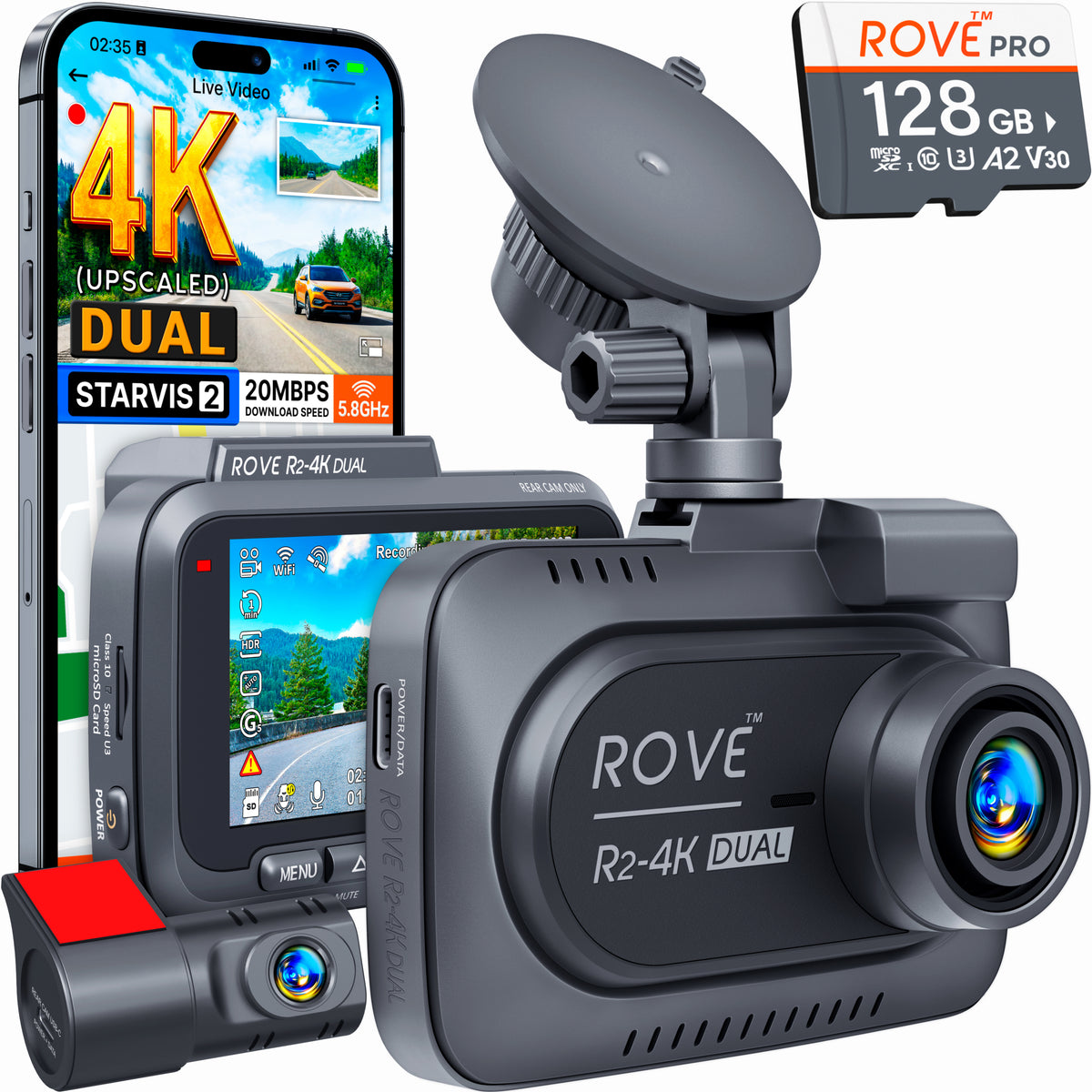
Buy the R2-4K Dual if you want front and rear recording in one kit that is easy to live with, available on Amazon.ca from ROVE itself: TechGearLab named it the best dash cam for most people, with sharp daytime footage and a GPS logger better than most. The 128GB card, mounts and long rear cable all come in the box. The trade-off is detail, since the front video is upscaled from a 2.5K sensor and the 1080P rear camera blurs distant plates. If night plates matter most, VIOFO's A229 Plus is the stronger choice.
Pros
- Sharp daytime front footage
- Wide combined front and rear coverage
- Built-in GPS logger and 3-inch screen
- 128GB card, mounts and cables in the box
- Easy setup; the app is optional
Cons
- Front 4K is upscaled from a native 2.5K sensor
- 1080P rear camera blurs distant plates
- Parking mode needs a separate hardwire kit
- Impact alerts must be cleared before it records again
As an Amazon Associate I earn from qualifying purchases. Disclosure
Overview
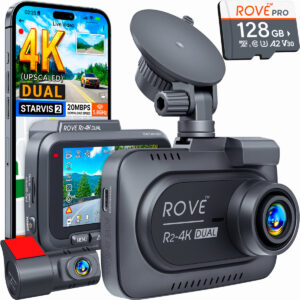
A front camera, a rear camera, GPS, Wi-Fi and a 128GB memory card all come in one box with the ROVE R2-4K Dual. It suits drivers who want evidence from behind the car as well as in front of it, without paying for a premium two-camera kit or buying a card separately.
ROVE launched the Dual in July 2024 as the two-camera version of its single-lens R2-4K, and it is sold alongside the step-up R2-4K Dual Pro rather than replaced by it. On Amazon.ca it is sold by ROVE’s own storefront, and the Canadian price sits well below its closest rival: in November 2026 Amazon.ca listed the Dual at $179.99 CAD against $349.99 CAD for VIOFO’s A229 Plus. TechGearLab, which tested it most recently (September 2025), scored it 79 out of 100 and named it the Best Dash Cam for Most People. Tom’s Guide (3.5 out of 5) and the independent tester VortexRadar (3 out of 5), reviewing it in September and October 2024, were more critical, above all of its night footage and its night-vision claims. Our 3.9 leans on TechGearLab’s daytime, coverage and GPS test results and on what comes in the box, and marks it down where the earlier tests found it weaker, chiefly at night.
Key Specifications
| Price (CAD) | $179.99 |
| Cameras | 2 (front and rear) |
| Front video | Native 2.5K, output as 4K (2160P) |
| Rear video | 1080P |
| Front sensor | Sony STARVIS 2 IMX675 |
| Viewing angles | 150° front, 140° rear |
| Screen | 3-inch IPS |
| Wi-Fi | 5.8GHz and 2.4GHz |
| GPS | Built in |
| Storage | microSD up to 1TB (128GB card included) |
| Operating temperature | -20°C to 70°C (-4°F to 158°F; supercapacitor, no battery) |
| Parking modes | Motion, time-lapse or collision (hardwire kit sold separately) |
| Warranty | 12 months, 15 if registered within 30 days |
ROVE R2-4K Dual Video Quality
In daylight the front camera does its main job well. TechGearLab found it competing for the top spot in its lineup for daytime capture: stopped at a light, its testers could read license plates two to three vehicles ahead from screenshots, and overhead street signs four to five vehicles ahead. Tom’s Guide was also impressed by the daytime footage and could pick out signs and plates, though it found the image a little grainy, especially from the rear camera, which it said may have been down to gloomy weather.
The 4K in the name describes the file, not the sensor. ROVE’s own product page now says the IMX675 captures native 2.5K video that is processed and upscaled to 4K, so the footage carries less detail than a camera with a true 4K sensor. VortexRadar also found that at its 4K setting the camera captures 25 frames per second inside a 30fps file, adding a repeated frame after every five. TechGearLab noticed some LED headlights and stoplights flashing in its footage, which it put down to the frame rate.
The rear camera is the weaker of the two. It records at 1080P, and every test noted the drop. Tom’s Guide found distant letters and numbers blurring together until cars came closer, and VortexRadar, which identified the rear sensor as a GalaxyCore GC2053, found it caught plates only on cars that were close and barely moving. TechGearLab was kinder, saying it could still make out the faces and clothing of drivers behind its test car. The rear camera swivels, so it can face the back window or the cabin.
Coverage is a strength. ROVE lists 150° for the front lens and 140° for the rear, and TechGearLab measured a combined 203° around the car, well above its lineup average, with a fish-eye curve at the edges that it said doesn’t hurt the footage. Both cameras record sound; TechGearLab found speech and music clear but noted a lot of road noise.
Night Recording: Testers Disagree
Night footage is where the three tests part ways. In its September 2025 test, TechGearLab called its night capture “similarly good, bordering on excellent,” crediting HDR processing for evening out glare from headlights against a dark rural road, with sign lettering still readable.
Tom’s Guide, testing in October 2024, reached the opposite verdict. It found no proper night vision mode despite ROVE’s “Super Night Vision” claim, with footage at the mercy of street lights, and said both cameras struggled to pick out license plates at night, particularly while moving. On unlit roads, it said, you mostly see the strip lit by your headlights.
VortexRadar landed in between. It credited the Dual’s HDR, new for ROVE’s two-camera model, with handling headlight glare on plates better than the WDR on ROVE’s single-camera models. Against VIOFO’s A229 Plus, which uses the same front sensor, it found the VIOFO captured slightly more detail with less noise, and put the difference down to image processing. ROVE’s firmware notes list image-processing updates aimed at clearer license plates in November 2024 and June 2025, after the two critical tests and before TechGearLab’s.
Parking Mode, GPS and Power
Recording while parked needs ROVE’s hardwire kit, sold separately; ROVE says parking mode has built-in voltage protection and shuts off before it could drain the car battery. With the kit installed, VortexRadar tested three modes in September 2024. Motion detection woke only the front camera, within one to two seconds; ROVE’s firmware notes say an October 2024 update added rear-camera motion detection in parking mode. Time-lapse records both cameras at one frame per second and switches to normal video with audio when it senses an impact, a change VortexRadar liked. Collision-only mode took about 10 seconds to start recording after a bump, so it can miss the moment itself.
VortexRadar also hit two habits worth knowing. After an impact while parked, the camera shows an alert that has to be cleared on screen, and until it is, the camera won’t resume recording when you drive off, so it advised mounting it where the screen stays visible. Running from a separate dash cam battery pack, the camera stayed off after the pack ran flat and had to be switched on by hand.
The built-in GPS stamps speed and location on every clip, and TechGearLab rated its logger better than most it tried, updating every few seconds on the overlay. Tom’s Guide noted that GPS also sets the clock, so you shouldn’t need to reset it for daylight saving time. The camera runs on a supercapacitor rather than a battery, which ROVE rates for use from -20°C to 70°C (-4°F to 158°F). ROVE’s warranty runs 12 months, extended to 15 if you register the camera within 30 days of purchase.
Setup, App and Wi-Fi Downloads
Tom’s Guide found setup extremely easy: plug it in, format the card when prompted, set the time zone and it starts recording. Installing both cameras with hidden cables takes longer; TechGearLab clocked 32 minutes for the full install and first setup. The box covers most of it, with suction and adhesive mounts, a 6.5-metre rear camera cable, a 3.7-metre (12-foot) power cable, cable clips and trim tools. Tom’s Guide found the locking suction mount extremely secure.
The 3-inch screen and buttons handle every setting, and VortexRadar liked that the menu opens without stopping the recording. Tom’s Guide suggested three changes out of the box. Set the screen to switch off after a minute, since Tom’s Guide said the live preview can be distracting; lower the loud voice prompts; and raise the loop length from its 1-minute default to 3, 5 or 10 minutes so clips are easier to sort.
The ROVE app is optional. It offers a live view (useful for aiming the rear camera), settings, playback and over-the-air firmware updates, though TechGearLab noted it asks you to create an account. ROVE rates Wi-Fi downloads at up to 20MB/s, which VortexRadar noted is well up on ROVE’s single-camera models. Even so, TechGearLab found each clip took 15+ seconds to reach a phone and preferred pulling the card instead.
How Does It Stack Up Against the Competition?
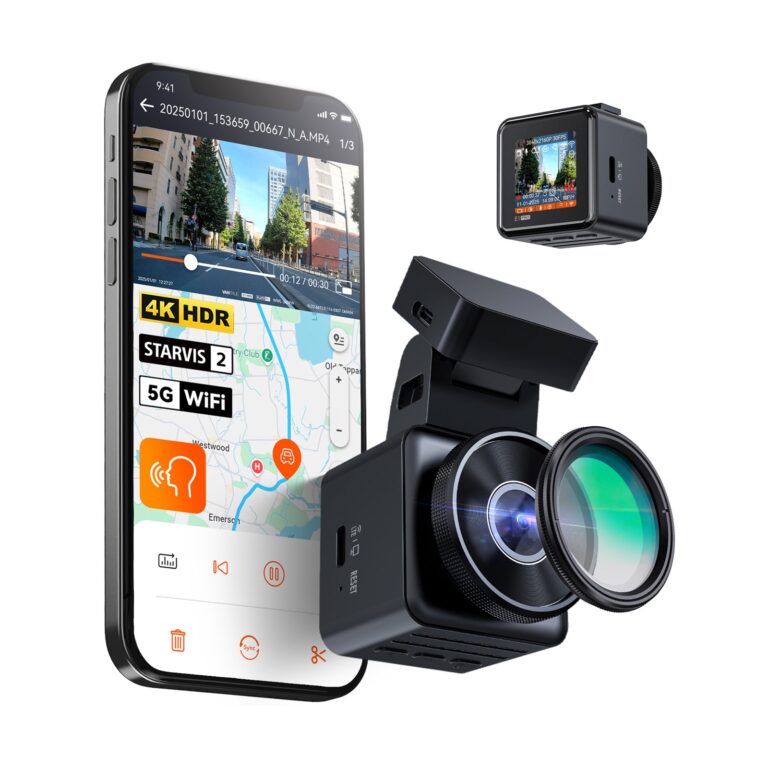
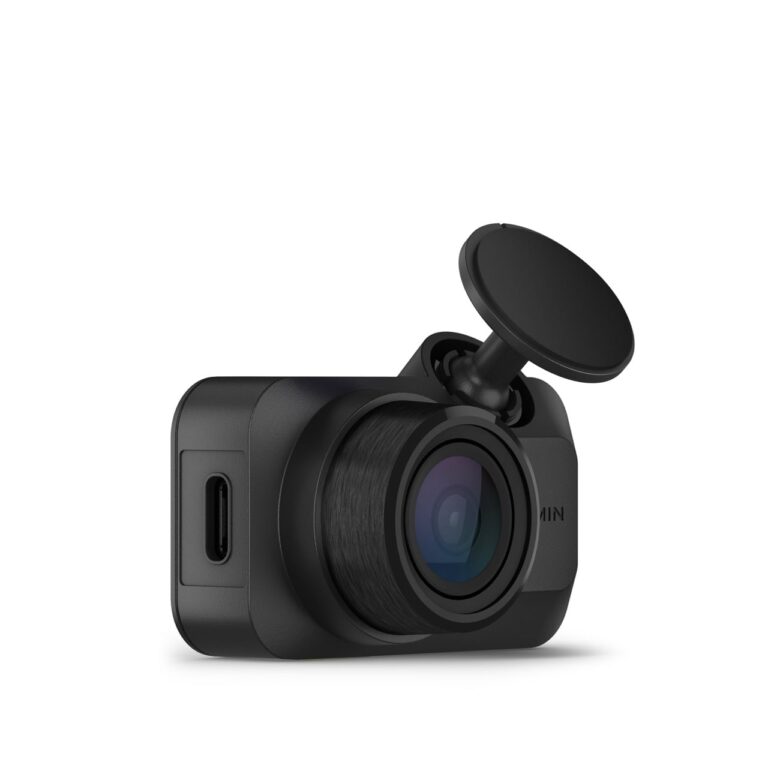
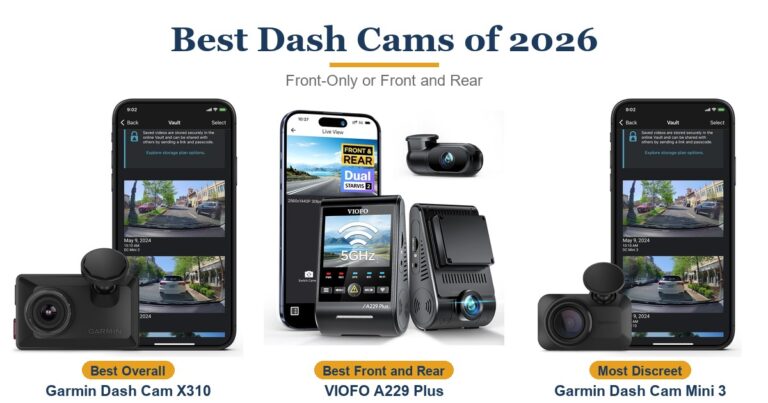
The R2-4K Dual’s closest rival is VIOFO’s A229 Plus, which shares its front sensor; REDTIGER’s F17 adds a cabin camera, and Garmin’s Mini 3 drops the rear camera for the simplest possible setup.
| Feature | ROVE R2-4K Dual | VIOFO A229 Plus | REDTIGER F17 4K 3-Channel Dash Cam | Garmin Dash Cam Mini 3 |
|---|---|---|---|---|
| Price (CAD) | $179.99 | $349.99 | $259.00 | Deal $139.99 |
| Cameras | Front + rear | Front + rear | Front + cabin + rear | Front only |
| Front video | 4K file from a 5MP IMX675 sensor | 1440P, up to 60fps | 4K file from a 5MP IMX675 sensor | 1080p |
| Rear video | 1080P | 1440P (STARVIS 2 IMX675) | 1080P (plus 1080P cabin) | No rear camera |
| Screen | 3-inch IPS | 2.4-inch | 3-inch IPS | No screen |
| GPS | Built in | In the mount | In the mount | No GPS tracking |
| Memory card in the box | 128GB | Optional, sold separately | 64GB | Not included |
| Rated operating temperature | -20°C to 70°C (-4°F to 158°F) | -20°C to 65°C (-4°F to 149°F) | -20°C to 70°C (-4°F to 158°F) | -20°C to 60°C (-4°F to 140°F) |
| TTP Review | This review ↑ | Read our review → | Read our review → | Read our review → |
| Amazon | View on Amazon | View on Amazon | View on Amazon | View on Amazon |
Prices change frequently — always verify current pricing before purchasing.
ROVE R2-4K Dual: Worth It for Affordable Front-and-Rear Coverage
If you drive mostly by day or on lit streets and want both ends of the car on record, the R2-4K Dual is an easy setup to live with: a big screen, built-in GPS, a capable app and a memory card in the box. Its Canadian price makes the case stronger: in November 2026 it cost less on Amazon.ca than both the REDTIGER and the VIOFO in the table above. For winter parking, ROVE rates the supercapacitor-powered camera down to -20°C (-4°F), so nights colder than that are beyond its rated range. The trade-off is image quality at the edges of its job, since the front video is upscaled from a 2.5K sensor.
Look elsewhere if plates behind you matter or you drive a lot of unlit roads. VIOFO’s A229 Plus uses the same front sensor, adds a 1440P STARVIS 2 rear camera and, in VortexRadar’s side-by-side test, pulled slightly more detail out of the dark. Ride-share drivers and parents who want the back seat recorded should look at the REDTIGER F17, which adds an infrared cabin camera. If you only need a front camera, Garmin’s Mini 3 took five minutes to install in TechGearLab’s test, though it has no screen or GPS tracking.
Sources
- ROVE — R2-4K DUAL Dash Cam Front and Rear (official product page)
- ROVE — ROVE INNOTECH Unveils the All-New ROVE R2-4K DUAL Dash Cam
- ROVE — Warranty Information
- ROVE R2-4K Dual — Amazon.ca Product Listing
- TechGearLab — Rove R2-4K Dual Review
- Tom’s Guide — Rove R2-4K Dual dash cam review
- VortexRadar — Rove R2-4K Dual Dashcam Review
- VIOFO — A229 Plus 2CH Front and Rear Dash Cam
- REDTIGER — F17 3-Channel 4K 5G WiFi Dash Cam
- REDTIGER — F17 User Manual V2.0
- Garmin — Dash Cam Mini 3 Owner’s Manual
- TechGearLab — Garmin Mini 3 Review
- Tom’s Guide — Garmin Dash Cam Mini 3 review
Reader Poll
What matters most to you in a front-and-rear dash cam?
Help Our Editors Know What Matters to You
Explore on Amazon →